Introduction
One of the most renowned and significant figures in African history is Emperor Menelik II of Ethiopia (1844–1913). Menelik, who led Ethiopia during the Scramble for Africa, one of the most turbulent times in the continent’s history, is admired for his political acumen, military acumen, and visionary modernization. Menelik steadfastly defended his country’s sovereignty as European powers divided Africa among themselves. In addition to maintaining Ethiopia’s independence, his leadership motivated future generations of Africans to oppose colonial rule.
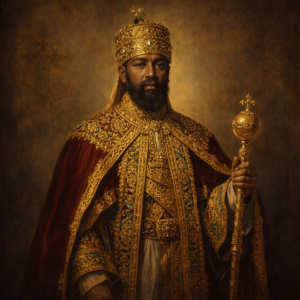
Menelik was born Sahle Maryam in Ankober, Shewa, and became well-known by combining his military prowess, tenacity, and diplomacy. He succeeded Emperor Yohannes IV as Emperor of Ethiopia in 1889 following a string of political battles. Menelik had a vision of Ethiopia as a modern, cohesive, and powerful empire that could compete with the world’s superpowers from the start of his rule. His efforts to modernize the empire’s institutions, increase its borders, and consolidate power laid the foundation for the Ethiopia of today.
Early Life and Rise to Power
Menelik made remarkable and extensive modernization efforts. Modern weapons, the telephone, and electricity were among the new technologies he brought about. In addition, he promoted trade with other countries and constructed roads and bridges to link remote areas of his empire. Making Addis Ababa the capital in the 1890s was one of his most notable accomplishments. Due to its advantageous location and abundance of natural resources, Addis Ababa emerged as the nation’s political and economic hub. Menelik had a vision for Ethiopia that went beyond survival to include progress. In a distinctively Ethiopian manner, he aimed to modernize Ethiopia while maintaining its cultural and spiritual identity.

Modernization and Vision for Ethiopia
Menelik’s struggle against imperialism by Europeans, particularly the Italians, stands out as one of the most notable legacies associated with him. This was evident following the signing of the Treaty of Wuchale in 1889 when the Italians used mistranslation to try and make Ethiopia a protectorate. While the Amharic translation favored Ethiopian sovereignty, the Italian version had a different implication. Upon realizing the deceitfulness in the treaty, Menelik denied the claims of the Italians and prepared his nation for a showdown.
He, however, did more than just fight. He improved the capabilities of Ethiopia through modernization, purchasing weapons and forging relationships that helped to unify various parts of Ethiopia towards a similar objective. All this proved vital in ensuring victory in the crucial Battle of Adwa in 1896, an event considered as one of the most significant in African history.
The Battle of Adwa
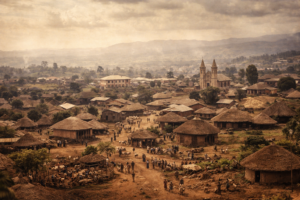
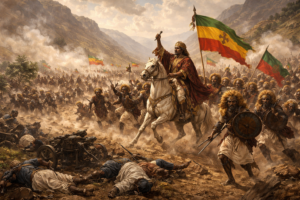
More than just a military conflict, the Battle of Adwa was a turning point in African pride and defiance. To protect their homeland from colonial conquest, Menelik rallied a sizable army composed of members of Ethiopia’s many ethnic groups. Ethiopian forces decisively defeated the Italian army on March 1, 1896. This triumph shattered the myth of white supremacy and stunned Europe. An African country had triumphed over a contemporary European power in open combat for the first time. Ethiopia’s independence was guaranteed by the Adwa victory, which also represented hope for the continent as a whole. For anti-colonial movements throughout Africa and the African diaspora, it turned into a lighthouse.
Diplomacy and Global Recognition
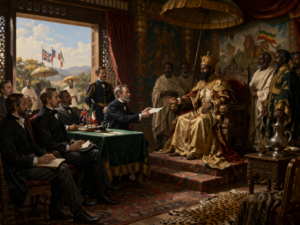
Menelik demonstrated his brilliance as a negotiator even outside the arena of war. After winning the battle of Adwa, he managed to get his country recognized internationally by many European nations. It was during an era where most of Africa’s leaders were having their territories colonized. His approach in handling matters was strategic and prudent, ensuring that his country was able to survive through negotiations and diplomacy.
He maintained a balance between standing firm and engaging in diplomatic relations. In protecting his country’s sovereignty, he created diplomatic ties and trading routes with other nations such as France, Russia, and Britain. Such alliances did not weaken his country’s sovereignty but rather improved its international standing without losing its sovereignty.
Controversies and Legacy
The reign of Emperor Menelik was not without its controversies, although he accomplished much during his lifetime. The conquests he led extended Ethiopia’s territorial boundaries, incorporating various territories into his empire at times by coercion. While admirers see these developments as part of the process of establishing a cohesive empire, detractors note the imperialistic parallels evident in Menelik’s approach to territorial expansion that were present in Europe.
During his final years, Emperor Menelik suffered from poor health, leading to political instability during his rule. This issue was exacerbated following his death in 1913, when Ethiopia had to deal with the vacuum left by their leader. Nonetheless, his vision lived on, and Menelik envisioned an Ethiopia that would be strong and independent.
Enduring Legacy of Emperor Menelik II
Menelik II is today remembered as an iconic figure and a national hero, symbolizing the indomitable spirit of Africans. The reign of Emperor Menelik II left a legacy of solidarity, visionary planning, and patriotism that persists even after his death. During his reign, Ethiopia not only managed to maintain its independence but also set the stage for the country’s subsequent development.
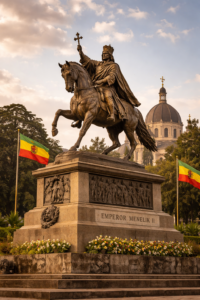
The Battle of Adwa commemoration is still one of the most important holidays in Ethiopia, marking the triumph of African resistance. In the capital city of Ethiopia, there are statues dedicated to Menelik that serve as reminders of the courageous leader who defied all attempts at colonizing his nation. Menelik’s legacy still influences people from different parts of the world, especially those who cherish their independence and national dignity.
Conclusion
A significant period in the history of Africa’s struggle against colonial rule is the reign of Emperor Menelik II. He demonstrated that even the most powerful empires could be overthrown by African unity, leadership, and vision. Menelik II cemented Ethiopia’s status as a proud and independent nation with his strategic genius at Adwa and his unwavering efforts to modernize his country. His life serves as a reminder that genuine leadership is characterized by purpose as well as power; the will to defend one’s people, culture, and sovereignty in the face of adversity.
More…