










































































Introduction
A Kingdom Built on Stone and Spirit
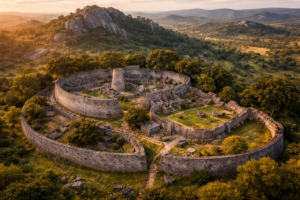
Great Zimbabwe was far more than just a city. Rather, it was an embodiment of all that is sovereignty, authority, and cultural identity. The term Zimbabwe originated from the word dzimba dza mabwe which means “stone houses” in Shona language. The impressive granite structures symbolized not only the architectural prowess of its inhabitants but also their military and organizational skills. This place was the home for royalty and spiritual leaders, whose responsibilities went beyond politics to religion and spiritual practices.
From here, they directed trade routes leading to the heart of Africa from the Indian Ocean coast. Various products such as gold, ivory, among others were traded through these routes, making Great Zimbabwe a wealthy city.
Architecture of Spirit and Power
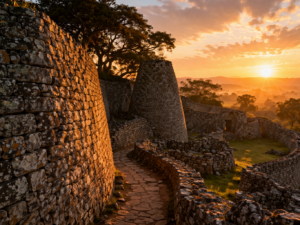
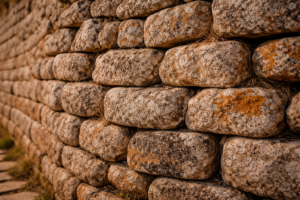
What makes Great Zimbabwe unique is not only its grandeur but its sacred geometry as well. The builders of the Great Enclosure crafted its walls, which soar up to ten meters in height, to represent the divine nature of royal power. They designed the enclosure with curved walls and narrow entrances, showing clear intention and careful planning. They reflected this thoughtfulness in the precise placement of each stone, constructing the structure without the use of mortar.
This structure served as the connection between the earthly and the spiritual realms, representing the king’s divine nature as well as his authority on Earth.
Trade, Wealth, and Influence
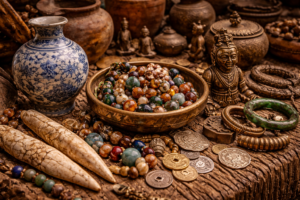
Evidence from discoveries, such as Chinese porcelains, Arabian glasses, and beautiful ornaments made of gold shows that Great Zimbabwe was located at the heart of a complex trade network. Ivory and gold entered the gates of the city in such abundance as to establish an effective connection between Shona people and the Swahili coast ports and the Asian and Middle Eastern markets via them. Trade activity contributed not only to the development of the region’s economy but also to the cultural prosperity of the area.
The significance of Great Zimbabwe was not confined to being just a trade center because it emerged as a strong economic and spiritual center of Southern Africa.
Sacred Stones and Royal Symbolism
The Conical Tower looms with an enigmatic air amid the Great Enclosure, its thick walls without windows evoking awe and admiration. Scholars widely understand it as a symbolic depiction of royal granaries; structures of fertility and prosperity that indicate the sacred role of kings in providing for their subjects. In this way, people viewed kingship not just as an exercise of political power, but as a responsibility intrinsically tied to the welfare of the population.
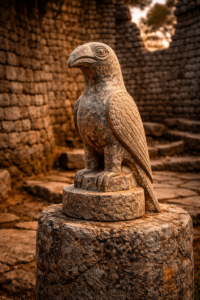
Close to the tower, the soapstone birds from Zimbabwe have been sculpted in elegant fashion to serve as potent totems of kingship and ancestry. Perched atop pillars, it is considered a link between the kings and the spirit world. Today, these impressive birds remain national icons of Zimbabwe, signifying unity and pride in their glorious history.
The Spirit of Uthamaki – African Kingship
In the same way that the Kikuyu believe that the kingship is vested with the sacred powers of the god Uthamaki, the Shona believe that their kings are vessels that are blessed by the spirits of their forefathers. Kingship in Great Zimbabwe was not just about governance, but it was deeply tied to spiritual stewardship. It was a position that kept in check the harmony between man, nature, and the spiritual forces that governed their existence.
The king maintained his legitimacy through ceremonies, rites, and religious observances that constantly reminded him of his duties to Mwari and his ancestors. It was not just about being the king; it was about maintaining his sacred duty. Therefore, the sacred stones of Great Zimbabwe were a testament to the kingship that was not only authoritative, but also deeply spiritual.
Decline and Legacy
Great Zimbabwe’s decline started around the 15th century as a result of overpopulation, drought, or perhaps even because of the changing of trade routes closer to the coastline. As a result of these circumstances, the city’s glory began to deteriorate as the people abandoned it for greener pastures elsewhere. Nonetheless, it continues to be an inspiration among modern day Zimbabweans who take great pride in their heritage.
Indeed, the ruins at Great Zimbabwe stand as powerful symbols of a sacred place. They show how long ago African civilizations built great centers of civilization.
Conclusion
The Great Zimbabwe Ruins are not mere relics of stone but living monuments to power, kingship, and faith. Silently, they continue to tell the story of a time when Africa built its empires with blocks of granite and ruled through wisdom, spirituality, and unity. To stand among these stones is to feel the pulse of a civilization which once ruled; not through conquest, but sacred authority and with ancestral blessing.
It is a place where the ancient grandeur of Africa still breathes, reminding us that greatness was not imported. It was born here!




Pingback: The Forgotten Giants of Ancient African History - Real African Diary