

Why African Startups Matter Now
Across African cities and villages, small businesses are quietly inventing the future. What begins as an informal market stall, backyard workshop, or WhatsApp group can; with the right mix of persistence, product-market fit, and resources, become a company serving millions across borders. These startups matter because they create jobs, solve local problems with local knowledge, and rewrite global narratives about African innovation.

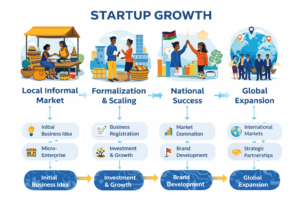
Typical Path: Informal → Formal → Regional → Global
Most fast-growing African startups follow a loose path:
-
Informal roots: Testing products/services in local markets or communities.
-
Formalization: Registering the business, opening bank accounts, and documenting operations.
-
Regional traction: Expanding across cities or neighboring countries.
-
Global scaling: Attracting international partners, investments, and customers.
Each stage brings new challenges; regulatory complexity, talent shortages, logistics, and access to capital. Successful founders plan for those transitions early.
Three Core Growth Engines
1. Product-Market Fit in Local Contexts
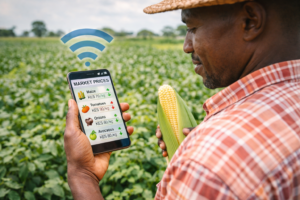
Startups that succeed long-term solve real local problems; affordable payments, last-mile logistics, agri-solutions for smallholder farmers, or mobile health tools. Proving value with real users locally is the strongest foundation for broader growth.
2. Revenue Before Funding (Sustainable Unit Economics)
Many African startups prioritize sustainable revenue models early; subscriptions, fees-for-service, and B2B contracts — rather than depending entirely on grants. When unit economics work, investors pay attention.
3. Networked Partnerships and Ecosystems
Scaling often requires partnerships: logistics firms, telcos, payment providers, and diaspora networks. Hubs and accelerators in Lagos, Nairobi, Cape Town, and Accra help founders access mentorship, talent, and pilot customers.

Funding Routes: From Microloans to Venture Capital
Access to capital is the classic blocker, but there are multiple routes:
-
Bootstrapping & Revenue: Many founders grow on customer revenue and microloans.
-
Angel investors & local funds: Early backing from local angels and impact funds.
-
Accelerators & grants: Useful for early-stage validation and networks.
-
Venture Capital: For high-growth startups with scalable models.
-
Corporate partnerships & strategic investors: Telcos, FMCGs, and banks can offer distribution and credibility.
A smart funding strategy mixes revenues with staged external capital, matching capital type to growth milestones.

Operational Challenges & Practical Solutions
Talent shortages: Build remote teams, invest in training, or partner with universities.
Regulatory hurdles: Engage regulators early, use local counsel, and pilot in receptive jurisdictions.
Logistics & payments: Integrate multiple payment rails and reliable last-mile partners.
Trust & brand: Use local champions, transparent policies, and strong customer service to build credibility.

Real-World Examples (Short Profiles)
-
Fintechs that started as informal agents and now process cross-border payments for millions.
-
Agri-tech startups that began as community trials and now run pan-African supply chains.
-
E-commerce brands that moved from market stalls to export platforms using diaspora demand.

Playbook: Practical Steps for Founders
-
Start with real users: Validate quickly and iterate.
-
Formalize early: Legal registration, basic accounting, and a business bank account unlock growth.
-
Measure unit economics: Know your CAC, LTV, and break-even points.
-
Build core partnerships: Logistics, payments, distribution, and regulatory allies.
-
Hire strategically: Prioritize operational hires before scaling headcount.
-
Plan funding rounds by milestones: Use seed, pre-Series A, and Series A as tools, not targets.
-
Protect IP & data: Compliance builds trust for international customers.

Scale with Purpose
Going from informal to global is not only about size — it’s about impact and resilience. The startups that scale successfully are those that solve real problems, keep sustainable economics front and center, and build partnerships rooted in trust. When African entrepreneurs grow, the continent grows with them.