










































































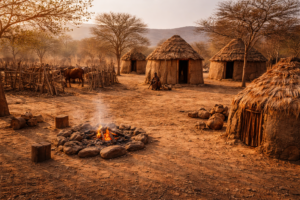
In this parched and sun-scorched part of the world, where the land is as reddish as old blood and time passes with the rhythms of cattle bells, the Himba community lives through their memory. Not the kind of memory inscribed in texts, the kind that can be imparted through skin, woven in hair, spoken in fire, and memorialized as the word of the law.
For the Himba, culture is not something they recall occasionally; they enact it every day. Through ritual, they preserve identity against drought, distance, and the reach of modernity.
Ritual as Daily Life, Not Ceremony
As with the Himba, the rituals are not restricted between the celebration days and the sacred days. These rituals are an integral part of the activities the Himba people undertake, including waking, grooming, cooking, and gathering. This is how the culture is preserved: not in museums but in repetition.
Every ritual holds a lesson. Every act holds a lesson that teaches the children who they are and where and how they belong.
Wearing the Earth Itself (Otjize)
Probably the most familiar Himba ritual is the application of otjize, a red ochre, butterfat, and herb mixture, applied to the skin and hair of the female population. This is not ornamentation for beauty only. Otjize keeps the Himba body tied to the land. The reddish tint of otjize resonates with the soil on which they stand and with the blood of their ancestors. Otjize shields the skin against the burning rays of the sun. More than that, however, it signifies ownership. “To apply otjize means to proclaim, ‘I belong to that land, and that land knows me,’”
Girls learn these ritual practices from their mothers and aunts through imitation rather than instruction. In this way, elders pass knowledge from hand to hand and from generation to generation, without ever needing to commit it to paper.
Hair as a Language
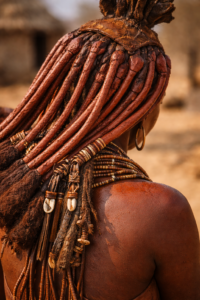
Among the Himba, hair speaks. Braids, plaits, and ornaments are tellers of tales about age, fertility, marital status, and social position. A child’s hairstyle differs from that of an unmarried woman, a married woman’s hair announces her new responsibilities, and an elder’s style commands respect before words can be said.
Hair rituals are communal: women sit together, braiding, coating, decorating; and in so doing, they pass on stories, advice, warnings, and laughter. Culture survives here, in these quiet, patient hours where hands work and memory flows freely. To cut or alter hair without ritual is to disrupt the language. That is why hairstyles endure; because they are not fashion, they are grammar.
The Sacred Fire
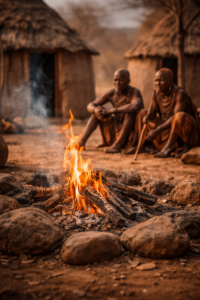
At the center of every Himba home is the eternal okuruwo, or sacred fire. It is always kept alight. “This fire is the bridge connecting the living to the ancestors,” says one informant. It is here that prayers are answered, where questions are asked and instructions are sought to legitimize decisions. “The birth of a child,” an informant adds, “the proposal of a marriage, a quarrel, this fire is present.”
The elders are tending the fire, not through power but through responsibility. And through this, they keep the power of the ancestors alive, ensuring that the past is always present, and the present, responsible. Indeed, in a world where everyone forgets soon enough, the Himba have decided to recall.
Rites of Passage
Life with the Himba is precisely defined. Childhood, adulthood, womanhood, elderhood: each status is attained only after rigorous preparation and initiation. Initiation rites teach discipline, tolerance, sex morality, and corporate responsibility. Marriage ties communities together, not individuals. Aging is based on knowledge and behavior, not solely on age.
These rituals ensure that identity does not arise from the self alone, but gains validation within the social world. Being who you are is the result of this process. This serves to protect the society from breakdown. Everyone knows who he or she is, and everyone else knows who one is supposed to be.
Objects That Remember
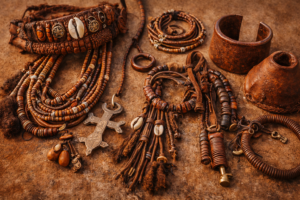
Necklace, leather clothing, beads, and metalware among the Himba are not ornaments. They are memory aids. Each one has a tale; of a wedding, a child, a gift, a harvest of plenty or want. Each one is a way of wearing one’s biography in public view for all to read. In this way, culture moves through bodies instead of bookshelves.
Oral Tradition
Stories, songs, proverbs, and praise poems are all an integral part of the Himba culture, just like water flows through arid land. Information isn’t archived; it’s performed. Elders tell tales of lineage, morals, and ancestor acts in communal gatherings. The messages are absorbed by children, not as teachings, but as ambience, their natural growth into it.
Ritual opens the space where the narrative voice becomes authoritative. A story shared around the sacred fire is more than entertainment, teaching and binding.
Holding the Line in a Changing World
Tourism, education, religion, and governmental influence are forces against the lives of the Himba people. But religious practices are the defining lines for them; flexible yet strong. In some practices, the form changes, and the meaning changes as well. It is the brilliance of rituals that they achieve change without compromise.
By doing culture rather than merely talking about it, the Himba preserve their identity even in moments of contact.
Culture That Breathes
The Himba do not preserve their culture through resistance against time. They preserve their culture through moving with time, carrying their ancestors on their skin, in their hair, in their fire, and in their voices. Ritual, for them, is not nostalgia. It is infrastructure.
As long as the fire burns, people mix the ochre, braid the hair, and tell the stories, the Himba remain; not trapped in the past, but grounded in it.



It’s really a nice and helpful piece of info. I’m glad that you shared this useful information with us. Please keep us informed like this. Thanks for sharing.