










































































Introduction
Not many musicians are known as much in African music and politics as Fela Kuti. He was an artist who openly referred to himself as “the Black President.” Unlike some other musicians, Fela was not only an artist but a movement and an inspiration. With Afrobeat, he created not just a music genre; rather, he invented a tool for fighting oppression and spreading awareness. Combining African traditional rhythms and jazz, funk, and highlife, he managed to create something powerful and inspirational. Fela’s music touched upon issues related to poverty, military dictatorship, corruption, and social inequality and helped draw the attention of people to problems.
For Fela, performance was another way to express political views and spread awareness. Music became the language for his revolutionary message. His lyrics served as education and provocation, whereas his performances could be considered an embodiment of resistance and freedom. Nowadays, Fela is still remembered, and Afrobeat music continues shaping global culture, while the idea of his songs is being discussed.

The Birth of a Revolutionary Sound
Born in Abeokuta, Nigeria, in 1938, Fela Kuti came from a politically conscious family which had a profound effect on his political views at a young age. Fela’s mother, Funmilayo Ransome-Kuti, was a groundbreaking feminist who fought the power of colonialism and championed equal rights for women. The audacity and fearlessness displayed by her had a significant impact on him and influenced his fearless attitude later in life.
In the mid-1960s, Fela travelled to England in order to pursue his musical interests, where he started developing his ideas about sound, combining jazz with highlife music, a widely popular type of music in Africa. However, he truly changed when he went to America in 1969. While there, he discovered the vibrant energy of the Black Power movement, and also listened to music by James Brown. He became inspired by revolutionary figures who advocated for African identity and struggle. Once back home, he was ready to use music to make a difference.

Afrobeat: More Than Music
Afrobeat was more than just music. It was a revolution created by Fela Kuti. This is because the style itself was a revolutionary combination of rhythmic traditional African sounds with jazz, funk, and highlife music. The length of the songs made them quite unique; lengthy, mesmerizing and even explosive. Multiple layers of horn parts, percussion, and electric guitar accompanied politically charged lyrics that attacked various forms of injustice. Examples of his songs include “Zombie”, “Water No Get Enemy” and “Sorrow, Tears & Blood”, which were all political satires against the corrupt regimes, the military and other forms of social discrimination.
By choosing Pidgin English as the language to perform his songs in, Fela managed to reach everyone with his message. It was not restricted only to the educated and upper class. Afrobeat became much more than music.

The Man, the Myth, the Rebel
Fela Kuti was a bold man who was ready to stand up to the authorities. He refused to separate art from politics, and he devoted his entire existence to political activism. In the 1970s, he created Kalakuta Republic, a so-called free city in Lagos where he lived together with his band members, collaborators, and his Queens. It was an expression of his rebellion, a place where he could fully express himself.
For the Nigerian authorities, Fela Kuti became an even greater menace with the creation of Kalakuta. On the night of the February 18, 1977, soldiers broke into the commune and burned everything down. They physically assaulted Fela, and his mother, Funmilayo Ransome-Kuti, lost her life. The assault made Fela even more rebellious; he never retreated, despite all those threats and punishments from the government. He always came back to the stage, using his songs to fight injustice, oppression, and slavery in Africa.
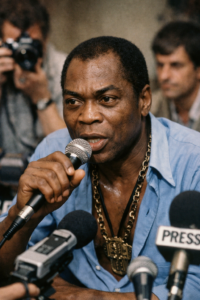
Legacy That Lives On
Although Fela Kuti died in 1997, his legacy continues. His sons Femi Kuti and Seun Kuti continue the family’s musical tradition by making Afrobeat and keeping the spirit of opposition and truth alive through their music. The impact of Fela’s revolutionary combination of rhythm and politics can be felt by many artists around the world. Burna Boy, Erykah Badu, Questlove, just some of those who have been influenced by him. While Afrobeat is now different from what it was at the time when Fela was actively working on his music, its origins are undeniably his own.
Felabration festival, which takes place each year in Lagos, celebrates Fela’s music and his contributions to it. His message resonates even today because the topics he was fighting for have not changed much since then. His flame still burns brightly in all of those who fight injustice using the medium of music.

Conclusion
Fela Kuti famously stated, “Music is the weapon of the future.” In saying so, he certainly meant to imply something by it, but what made him great is that he actually lived up to it. Through all of his songs and lyrics, he gave life to his weapon against oppression through music. He never made music to make others feel entertained. He used his music not only to awaken, challenge, and inspire people, but also to confront the oppressors and give voice to the oppressed through music. Spirituality and struggle came together to create a unique African sound that would not be cowed.
Listening to Fela is like connecting oneself to a legacy of African people and their struggles. To listen to him is to become part of the movement and carry on the fight against the oppressive forces. Fela has left behind a legacy that will always live on. This is why he has had such a lasting influence in the world and why his sound can continue to resonate through generations.



Pingback: Fela Kuti and the Grammy He Won After Death - Real African Diary