










































































Introduction
Even before ink came into contact with paper in West Africa, the Akan tribe in what is today Ghana and Côte d’Ivoire had its own language, rich in meaning but lacking an alphabet. The language was called Adinkra, and it was a philosophy expressed through images on cloth, wood, liquid gold, and walls. They each hold a meaning. They each convey a proverb. And in combination, they represent one of the oldest forms of nonverbal communication in Africa, a language of silence, but one which is very expressive of the Akan worldview and belief system.
To wear Adinkra is to wear wisdom. To carve Adinkra is to preserve memory. And to understand, to comprehend, is to peer into the soul of a nation that knew that art and ethics converge.
The Origins
Adinkra cloth was traditionally used by the Akan communities of Ghana and Côte d’Ivoire during the funeral ceremonies of their royal members as a means of expressing mourning and remembrance. In the Akan language, the name Adinkra translates into “di nkra” which means “to say farewell.” It is worth noting that the use of Adinkra cloth changed through time. This type of fabric, which was first created as a mourning cloth for the funerals, became an entire visual language as well.
Every symbol of Adinkra cloth embodies a certain proverb or a moral message connected with the Akan traditions. Today, there are many types of such cloth available all over the world. Symbols of Adinkra appear on various types of clothing, jewelry, works of art, architectural designs, and even emblems of universities and governments. All of the symbols carry a deep meaning and tell the viewers their stories and moral messages.
The Symbols and Their Meaning
Each and every Adinkra symbol embodies a lesson in morality, spirituality, or ancient sayings. These symbols do not merely exist as designs, but they hold values that have guided the Akan community for many years. The symbols are found on fabrics, buildings, emblems, jewelry, and other forms of art, and they remind the community that knowledge can also be passed down in the form of designs and not just in words. These symbols embody values ranging from religion and leadership to freedom, endurance, and respect.
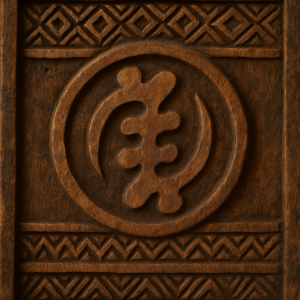
Gye Nyame (“Except for God”)
Among all Adinkra symbols, Gye Nyame is certainly the most recognizable and honored. Signifying “Except for God,” it captures the belief among the Akan people that there is nothing that can be successful without the will of God and His supreme authority. Gye Nyame is thus a symbol of resilience and strength because of the firm belief that God always stays by his people no matter what happens.
Nowadays, you can find this symbol in churches, buildings, jewelries, clothes, and even emblems in Ghana. Thus, the significance of spirituality in Akan culture still has its place, which makes Gye Nyame one of the greatest representatives of African religious philosophy.
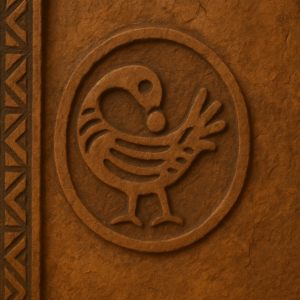
Sankofa (“Return and Get It”)
The Sankofa bird symbol is usually depicted as a bird whose legs point forward but its head points backward in an attempt to retrieve an egg held on its back. Through this impressive symbol, there is a strong message being conveyed that the basis of progress lies in recollection and understanding of past events. Sankofa is not concerned with the past, but it focuses on retrieving useful information that will be of great importance in shaping the future.
Sankofa has emerged into an important cultural symbol among Africans for regaining a connection with history. This symbol brings to mind the idea that gaining a connection with past events does not impede but rather empowers one to make progress.
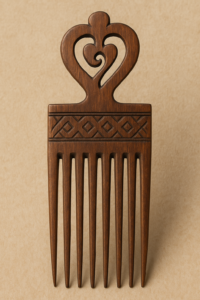
Duafe (“Wooden Comb”)
The Duafe, otherwise referred to as a wooden comb, is an indication of femininity, beauty, nurturing and kindness. The inspiration for the wooden comb comes from the Akan woman’s comb, which highlights not only physical beauty but also traits such as dignity, compassion, kindness and patience. Akan philosophy considers true beauty as a reflection of one’s personality as much as one’s appearance.
Furthermore, the symbol of Duafe emphasizes self-respect and discipline. Self-care is considered an act of showing respect to oneself and the community as well. In the modern world, Duafe symbolizes how strength can be displayed in terms of gentleness, wisdom and kindness. It recognizes the significant contribution of women in keeping the family and community together.
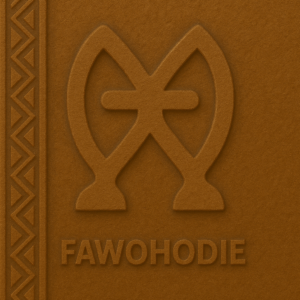
Fawohodie (“Independence and Freedom”)
The symbol of Fawohodie signifies freedom, liberty, and emancipation. This symbol stands for the idea that each individual has the right to live with dignity and make his or her own decisions without oppression and fear. Freedom is a natural right for all humans and cannot be viewed as some sort of gift from somebody else’s side.
Fawohodie is closely related to political liberation, personal accountability, and self-determination. This symbol urges an individual to act in accordance with his or her beliefs instead of being subjected to oppression or intimidation. While Ghana was on its way to becoming an independent state, this ideal proved itself to be relevant as the yearning for freedom originates within the human spirit first of all.
Adinkrahene (“Chief of Symbols”)
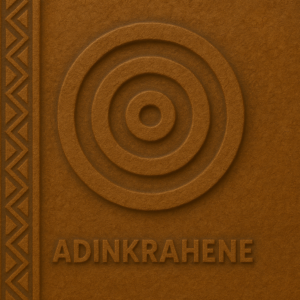
Referred to as the “Chief of Symbols,” Adinkrahene is associated with leadership, excellence, charisma, and authority. It is the most significant of all Adinkra symbols, appearing in the middle of other symbols, in the same way, a great leader sits at the core of the community. In accordance with the Akan belief system, the measure of a leader is not determined by wealth or power but wisdom, integrity, humbleness, and service.
The meaning of this symbol implies that true authority means gaining recognition and admiration of others through exemplary behavior and wise decisions. The message for leaders contained in this symbol is to lead and serve people and ensure their safety and welfare. Generations of people have been guided by the principles represented by this symbol.
The Art of Adinkra Making
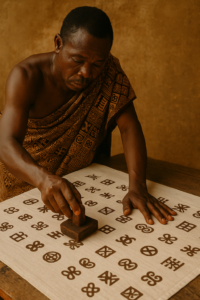
Making an Adinkra cloth is a painstaking process that combines both technical expertise and cultural symbolism. According to the age-old tradition, the symbols are carved individually into the gourd shells to serve as stamps for dyeing the cotton fabric with a rich black dye derived from the bark of the badie tree. Then each stamp is applied manually to the fabric, taking patience and skillfulness. Every single stamp and pattern used in Adinka design carries great significance and reflects the philosophy of the Akan culture.
Even though the technique has been modernized, its core has not changed. Today’s artists use traditional methods of manual stamping along with natural dyeing, modern fabrics, and even digital printing to present their works to the audience while maintaining cultural significance of the design. Be it museum displays, ceremonial garments, or fashionable designs, Adinkra cloth always proves that African art is not only decorative but also a carrier of history and culture.
Adinkra in Modern Africa
The Adinkra symbols in modern-day Ghana have transcended traditional uses as cloths and ceremonial purposes to be used on universities, government, and corporate logos, architecture, jewelry, fashion designs, and Afrocentric brands in Africa and the global diaspora. The symbolism serves as an important medium for connecting to the past through the visual representation of ancestral wisdom in the present time. It provides a medium between the sacred and secular, showing that culture is still alive in a world where everything changes quickly.
As indigenous African traditions are revived by the artists and designers across the continent and beyond, Adinkra has also seen its revival through the use of its symbols in contemporary art, typography, interior decoration, and media while maintaining its philosophy. These symbols not only decorate objects but also represent virtues such as faith, leadership, freedom, fortitude, and unity. This is evidence of the fact that African knowledge is timeless as Adinkra continues to live in the modern world as a moral language.
Conclusion
Adinkra makes us realize that not only were Africa’s first philosophers putting down their philosophies in writing in books but were rather inscribing them in forms of symbols through which their philosophies could resonate with future generations. In the case of the Akan philosophy, each and every symbol, pattern, or cloth carries within itself a certain philosophy.
These symbols and patterns still today serve as an inspiration for many young Africans and those who want to know their rich past culture. Adinkra thus lives on in whatever form it takes and as long as it continues to exist, the philosophy of Akan people shall forever remain alive as a piece of evidence that sometimes ideas are not just written but beautifully woven too!



Some really fantastic info , Glad I discovered this. “Courage is contagious. When a brave man takes a stand, the spines of others are stiffened.” by William Franklin Billy Graham.