

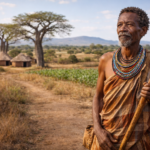
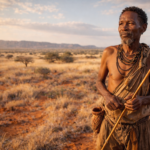
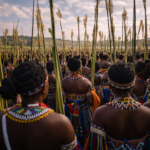





















San elder standing in the Kalahari Desert representing Khoisan heritage

Exploring the Culture and Traditions of the Khoisan People

3623 0

Introduction

The Khoisan represent one of the oldest cultures of human kind. Before the arrival of colonial powers and before any boundaries were erected within Southern Africa, they traversed the wide spaces of their world, existing in harmony with nature. The Khoisan did not just manage to coexist in nature; they knew it and understood its ways and rhythms. Their traditions and customs are not something abstract or written in some books. They are embodied in their daily life. Their worldview is based on respect for nature, ancestors, and animals and is a part of their culture.

The Khoisan have been here for many centuries already, and their contribution cannot be neglected in the history of African humanity. They can be considered the founders of the African civilization in the fullest sense of this word.

Who Are the Khoisan People?

The word “Khoisan” describes a collective name for the indigenous hunter-gatherer and pastoral peoples of Southern Africa, which include the San tribes also known as Bushmen and the Khoi-Khoi tribes. These groups can trace their cultural history to the earliest periods of human habitation. The modern descendants of these people inhabit southern parts of the African continent including countries of South Africa, Namibia, Botswana, and Angola.

These peoples have been able to survive in one of the toughest climates in Africa for many thousands of years. They knew how to hunt, find food and other useful products of vegetation and had special skills related to working with water sources. Unlike other people who believed in their domination over nature, they tried to understand and be in harmony with it. Modern science is more and more studying Khoisan cultures and admiring their knowledge about ecology, sustainability, and human adaptability.

Language: The Sound of Identity

Khoisan languages are some of the most distinct and oldest languages found anywhere in the world. The languages feature an incredible range of clicks consonants which produce unique rhythmic sound not found in any other major language groups, thus forming a very special part of Africa’s linguistic tradition. But beyond being mere tools for communication, the Khoisan languages contain the accumulated wisdom and ecological knowledge of generations past, as well as history and spiritual beliefs that connect people with their ancestors and nature.

For generations, Khoisan elders have been passing the stories, songs and traditions from one generation to another through spoken word. But colonialism and modernity have endangered many Khoisan languages, leaving them on the brink of extinction. To combat this danger, Khoisan elders, teachers and revivalists have been teaching their children about their native languages. Each word that is said and each story that is told becomes part of preserving the heritage. For Khoisans, speaking their language is not only a matter of cultural pride, but resistance.
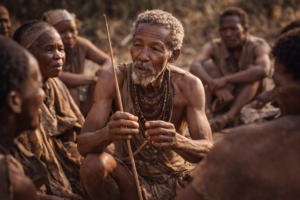
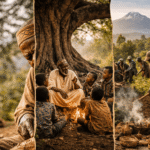
Khoisan elder sharing oral history with community
Oral storytelling preserves language, ecological knowledge, and ancestral memory among Khoisan communities.

Spiritual Beliefs and the Sacred Landscape

The spirituality of the Khoisan culture is characterized by its connection to nature, where human beings, animals, spirits of the ancestors, and even spirits themselves form a very balanced ecosystem. Unlike many modern societies that try to separate spirituality from everyday activities, the Khoisan try to connect religion to hunting, healing, telling stories, and community rituals. All activities are marked by the respect for nature and spiritual forces behind it.

One of the most prominent spiritual traditions practiced by the Khoisan people is trance dance or healing dance. In this ritual, people get in touch with their inner spirituality and heal sick, make their community harmonious again and also talk to spirits. The dance itself is not meant to entertain but to perform a very sacred ritual, which strengthens individuals and whole communities.

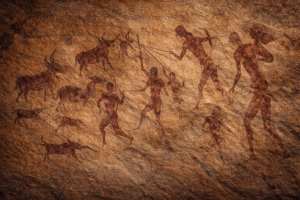
Also, spirituality of the Khoisan culture is preserved in the wonderful paintings made by their ancestors, which can be seen in Drakensberg mountains and other locations in Southern Africa.
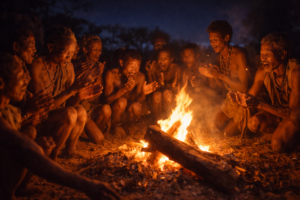
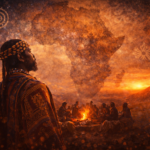
San trance healing dance ceremony around a fire
The Khoisan trance dance connects community healing with spiritual power and ancestral communication.

Hunting, Tracking, and Environmental Knowledge

Khoisan people managed to track the prey with such precision that it still astounds scientists, conservationists and wildlife experts. Khoisan people could interpret footprints, snapped branches, displaced soil, the presence of excrement and even the direction of the wind as they tracked their game across long distances. This was passed from generation to generation and helped them survive in some of the most hostile parts of Southern Africa.

Khoisan hunting practices reflected their respect for the environment. They made use of poisoned arrows obtained from local flora and fauna, shared the meat among the members of the community and made sure not to overhunt the animals so that the population would not become threatened. For them, life was dependent on the ecosystems which included knowledge about the medicinal value of certain plants, water sources, animal behavior and the seasons. It is now understood by many conservationists that Khoisan knowledge about the ecosystem can provide important information about tracking wildlife and conserving the environment.
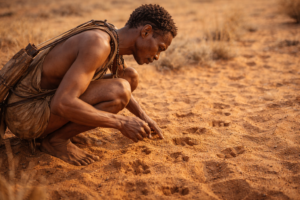
San hunter tracking footprints in desert sand
Khoisan tracking knowledge reflects thousands of years of environmental mastery.

Social Structure and Community Values

The Khoisan people used to live in nomadic groups where there was no need for any form of leadership, as people would make crucial decisions together. There were no kings and chiefs but only leaders who would guide the community and assist in making decisions in terms of their experience and wise judgment.

The Khoisan culture is characterized by the importance of equality, generosity, cooperation, and humility. Food and water resources were always shared among people with an aim of ensuring their survival, and one’s achievements depended not on the possession of goods but on the service rendered to other people. Wisdom, hunting, stories, and knowledge of nature were the attributes that brought prestige.

Such a type of organization helped to maintain unity within the community as well as its resistance to any possible difficulties. At the same time, it was totally different from the system implemented during the colonization.

Colonial Displacement and Cultural Survival

The settlement of Europeans in Southern Africa drastically affected the lives of the Khoisan communities. With the spread of colonization, their native land was taken away, their hunting grounds vanished, and they faced a struggle over livestock. Many were plagued with deadly epidemics that came with the foreigners, and discriminatory laws pushed thousands out of their homes. The generations of the Khoisan people suffered displacement, oppression, cultural discrimination, and social marginalization.

However, the Khoisan people have never disappeared. Having managed to survive numerous centuries of mistreatment and oppression, they have maintained their identity through oral history and culture. In present times, Khoisan activists fight for their rights to land ownership, cultural heritage preservation, language revival, and political recognition. These communities are trying to recover the lost history and preserve their unique culture which managed to survive in such unfavorable conditions. This struggle is not fueled by the longing for the past; it is motivated by the need to gain back their dignity and their identity.

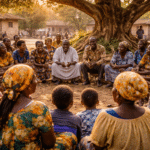
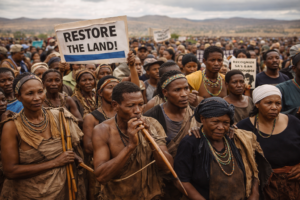
Contemporary Khoisan community gathering
Modern Khoisan communities preserve tradition while advocating for recognition and rights.

Art, Music, and Cultural Expression

Music, art, and storytelling have always been an integral part of Khoisan society, helping to preserve its history, cultural identity, and spiritual beliefs for future generations. Music accompanied by rhythmic clapping, dancing, and traditional musical instruments is a feature of Khoisan ceremonies, rituals, and other events of both spiritual and mundane importance. Through art and performance, a bond between different members of a community is created, and experience is passed down from generation to generation.

In addition, art in Khoisan society takes the form of beadwork and body ornaments made of stones, bones, shells, horns, and wood as well as clothes sewn from skins of hunted animals. In Khoisan society, art was both utilitarian and symbolic as it helped to reveal the belonging to certain tribes or groups. Every ornament, every pattern and shape had symbolic meanings, showing family ties, social status, or religious belief. All in all, all types of art in Khoisan society prove that art has never been decorative only.

Ancient San rock paintings in Southern Africa
Khoisan rock art documents spiritual journeys, animals, and early African cosmology.

Why Khoisan Culture Matters Today

The history of the Khoisan people dispels some popular myths regarding civilization in Africa. It shows that one can build a great society without constructing huge cities or large empires. The Khoisan created their civilization based on the wealth of knowledge, adaptation and great knowledge of nature around them. Their history shows that wisdom could be preserved through oral history and environmental care and high moral values in the same manner as through literature.

The Khoisan people still provide many wise lessons on proper attitude to nature, social responsibilities and harmonious relations with nature. Their sustainable hunting practices, resource use and relation to wildlife provide important examples for the modern people who face problems like climate change and biodiversity loss. With environmental issues becoming ever more pressing, the heritage of the Khoisan teaches that the future of the mankind cannot rely on technical achievements only; we need to return to some basic principles which our ancestors lived by for thousands of years.

Conclusion

The Khoisans are not relics of a former age but one of the most ancient cultures of mankind. Their language, traditions, and knowledge of nature continue to enrich Southern Africa and to expand our understanding of what civilization means. The story of the Khoisans teaches us that true civilization does not lie in monuments and great empires, but in the ability to coexist with others and nature.

When studying Khoisan culture, we step back in time to pre-conquest, pre-border, and pre-erasure Africa. Their story continues to be written down, preserved by people who have managed to maintain their thousand-year-old culture.

Related Post

Leave a comment

Your email address will not be published. Required fields are marked *