Introduction
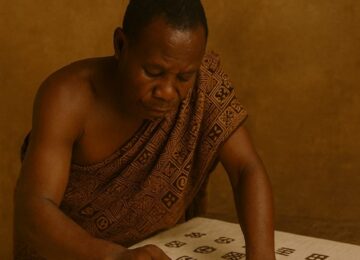
African art is more than just visual art; rather, it is a medium of communication that uses visual elements as means for conveying meaning. The artwork contains stories and narratives of its creators, such as stories whispered by their forefathers, silent prayers offered to God, or even bold declarations of who they are. These artworks are steeped in their culture and traditions as well as reflective of their values and beliefs.
These artworks have stories conveyed symbolically through images. For instance, beaded decorations worn by the Maasai people represent their culture and traditions.
Adinkra Symbols: Visual Proverbs of Wisdom
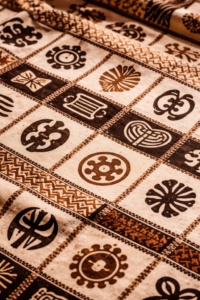
Adinkra symbols are part of the rich legacy of Africa and have their roots in Ghanaian culture, among the Akan people. These symbols are more than just decorative art. They embody wisdom through their visual representations, reflecting proverbs, lessons, and philosophical ideas that communities have transmitted from one generation to another.
Each symbol conveys its message using symbolism:
- Gye Nyame (“Except God”) – This symbol is based on a strong belief in the omnipotence and supremacy of God. It tells people that everything is subject to God’s will.
- Sankofa (“Return and get it”) – This symbol reminds us that we should learn from our past experiences to make our future brighter.
- Duafe (wooden comb) – This symbol represents beauty, hygiene, and feminine virtues.
Adinkra symbols can be found in various forms, from embroidery on fabric to carvings on wood and metal decorations. By embedding such symbolic meanings in everyday items, these symbols transform mundane objects into carriers of spiritual and moral significance, making them integral parts of people’s lives.
The Colors of Beads: A Language of Emotions and Identity
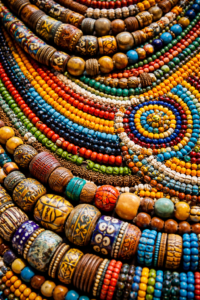
African communities use beads not only for beautification. They also use them as storytellers that carry important messages of identity, emotion, and tradition. For example, in Yoruba culture, beaded colors have a lot to say about power, spirituality, and hierarchy. This is especially evident during royal and sacred celebrations.
In Zulu culture, the pattern of beads serves as their own special language. Through this, they communicate messages of love, status, and other social information to the surrounding people.
- Red – passion, energy, life force.
- Blue – peace, faith, wisdom.
- Green – growth, fertility, regeneration.
- White – purity, spirituality.
- Black – ancestry, unity.
Beads are the ultimate symbols of storytelling in terms of both pattern and color, making it possible to convey important messages without uttering a single word.
Carvings and Masks: Faces of the Spirit World
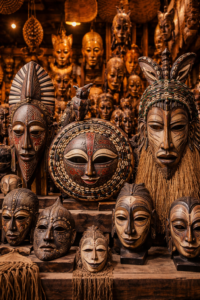
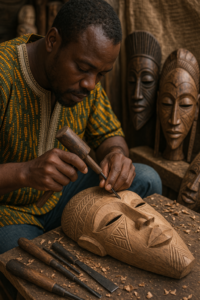
African masks and carvings act as significant channels for connecting with both the physical world and spirituality, ascribing beliefs that extend further than the material world. These objects have deeper spiritual connotations, rather than simply being pieces of art meant for admiration. Communities use these objects as religious instruments in rituals and dances to summon ancestors, worship deities, and maintain balance within society.
The Dogon masks in Mali, the Baule statues of Ivory Coast, and the Yoruba twin figures are some examples of masks rich with spiritual significance and symbolism. More often than not, these items are not just seen; they become part of performances and celebrations, allowing them to speak through movement and music.
Each carved line on the sculpture or mask carries deeper meaning, as artists transform art into a conversation with the spiritual world.
Art as the Soul of the Community
African art has never been separated from people’s lives, for it is an intrinsic part of them which shapes their identity and preserves a sense of collective memory. Art in Africa embellishes the home, celebrates the coming-of-age rituals, and reminds of one’s family traditions. Whether it is a mother who creates beautiful baskets, a sculptor who carves ancestors into stone statues, or a designer who transforms Adinkra symbols into the latest graphics, it all adds to an eternal dialogue between past and present.
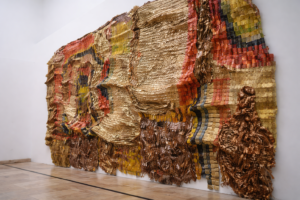
It is the eternal dialogue between generations that preserves the legacy of African art. Contemporary African artists El Anatsui and Peju Alatise inherit the traditions of their predecessors yet at the same time evolve the art form by introducing new dimensions.
Where Meaning Meets Creativity
Understanding African art requires listening, but not with one’s ears; it requires listening with one’s heart. African art presents an opportunity for people to look beyond the obvious, as each piece reveals the history of humankind in terms of their resilience, perseverance, and interrelatedness. Such artwork speaks for itself through many generations; it speaks about the past, but it also inspires the future.
No matter how old or new the piece of African art may be, it will always speak, eloquently and boldly. In doing so, it speaks about the spirit and heritage of its culture.