
















































Introduction
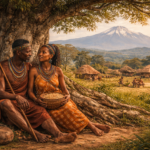
Long before the colonial boundaries of Kenya and long before Christianity redefined the language of spirituality, there existed amongst the Agĩkũyũ community a very strong version of creation; a version centered around the concepts of land, covenant, and a directive from Ngai. According to the Kikuyu, they are a people created by Ngai through Gĩkũyũ and Mũmbi. The first Kikuyu couple was picked by Ngai and placed at the foot of Mũkũyũ, the sacred fig tree, to form the foundation of this people. It is not enough to speak of its history, but rather its origins, for it is at this origin where we can find the very roots of Kikuyu identity.
Such an origin defines land, politics, gender equality, and spirituality. In essence, to know about the Kikuyu is to start at their origin.
The Sacred Encounter: Ngai and the Mountain
In the cosmological beliefs of Kikuyu, the creator god known as Mwene Nyaga, or Ngai, has his abode on Mount Kenya. The mountain is more than a geographical feature; it was regarded as sacred. It guided the way people offered prayers and sacrifices to the God of all and served as a directional point for them. Ngai summoned Gĩkũyũ and took him to Mũkũrwe wa Gathanga, a place of origin, where he bestowed upon him a fertile piece of land that extended towards Mount Kenya. More importantly, it was not just a mere gift, but an eternal covenant between man and land.
Accordingly, the land was not regarded as property to be appropriated and used for any personal gains, but rather a trust left by the ancestors as a divine legacy that should have been guarded and nurtured through subsequent generations.

Gĩkũyũ and Mũmbi
Ngai gave Gĩkũyũ a wife named Mũmbi, whose name can be translated as “creator” or “molder.” The two started the first home, the genesis of Kikuyu civilization. They had nine daughters:
- Wanjirũ
- Wambũi
- Wangarĩ
- Wanjikũ
- Wangũi
- Wangeci
- Wairimũ
- Nyambura
- Wamũyũ
Every daughter founded a family, leading to the formation of the nine fundamental Kikuyu families, called mĩhĩrĩga. Women, not men, are celebrated for founding Kikuyu civilization. The legend is rooted in creation rather than conquest, with identity based on nurturing and childbirth, not dominance. Women played a crucial role in the genealogical system by being the descendants’ mothers, suggesting a matrilineal society that acknowledged and respected female supremacy and harmony. The society’s beliefs reflected a culture where women were not mere appendages to men but vital components of society, culture, and identity.
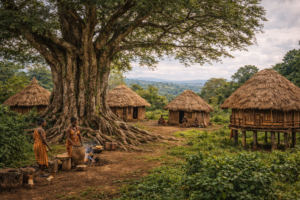
The Mugumo Tree and Covenant Ritual
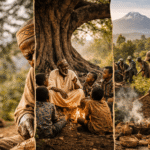
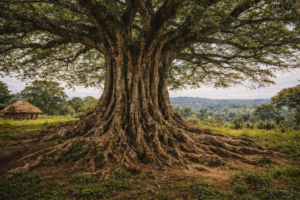
But as the daughters grew up, a crucial question arose: Who would take the daughters in marriage and ensure the continuity of their families? As a result, God told him to make a sacrifice under the mugumo tree. As directed by God, he did the sacrifice, out of which nine men arose to marry his daughters. It is during this time when some crucial lessons were learned:
- The land was holy, hence was to be treated with utmost respect.
- Marriage was vital to the unity of the clan.
- Obedience to God ensured continuation and blessings.
The mugumo tree was no longer merely a place where they took shade; it became a sacred altar where destinies were made and where people’s lives were determined.
Clan Identity and Social Order
There was no central monarchy among the Kikuyu, who instead developed a well-thought-out and well-rounded process of governance based on community systems, such as:
- Clans (mĩhĩrĩga)
- Age sets (riika)
- Elders’ councils (kĩama)
Each of these performed different functions within the society and contributed to the maintenance of order, identity, and longevity. The clans created lineage and a place of belonging, while age sets were used to organize generations into communities with similar duties, and elders’ councils brought wisdom and guidance. There was no concentration of power in one person or family line; rather, power belonged to the many and was cyclical in nature; passing through generations. This allowed for greater accountability, reduced long-term oppression by one generation, and ensured that leadership was both acquired and distributed. This is evidence of an exceptionally well-developed political ideology that proves that even before colonization, the Kikuyu were capable of developing their own model of governance.
Land as Identity, Not Commodity
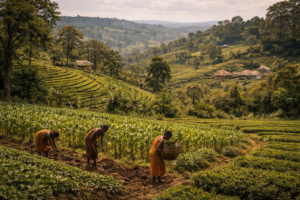
In the Kikuyu story of creation, land is neither a property nor even an object to be sold. Ngai did not give ownership of land to Gĩkũyũ. He simply handed it to him as an inheritance. The good fertility of the soil, at a cooler altitude, not only provided means of agriculture and feeding, but also developed spiritualism. The land turned into a link between the Kikuyu, their ancestors, and Ngai. Therefore, the people felt they were inalienably united with the land which was their home. Land cannot be traded or conquered as it belonged to Ngai and had been handed down to the people. This is why its seizure by the colonizers meant spiritual desecration for them.
The conviction that land was given as a divine legacy helped in resistance to oppression. Since it belonged to Ngai, no one, neither the colonizers nor any other authority, had any right over the land.
Gender, Balance, and Cultural Evolution
Oral narratives about Gĩkũyũ origin indicate that in the early days, there was an inclination towards matriarchy in the Gĩkũyũ communities before the adoption of patriarchy. Irrespective of the literalness or symbolism of such stories, it is always true that women have the origin, the root, from which life springs and identities arise. In such oral narratives, Mũmbi is no passive bystander. She is central to all the creation processes. She is the creator of a family and society. Her story is the emergence of nationhood, not by force but birth and nurturing.
The idea of balance is crucial here, since it shows a complementary system. A system where both the masculine and feminine elements of power coexist in creation and leadership. Hence cultural evolution does not wipe out origins. In the Gĩkũyũ view of things, both men and women hold leadership positions that complement each other. It implies that cultural evolution does not wipe out origins, it only builds on top of them.
Spiritual Continuity Today
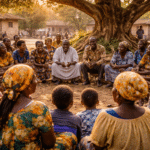
Today, Gĩkũyũ culture retains significant aspects of their spiritual tradition. Most people pray towards Mount Kenya because it is considered a link between heaven and earth. They have clan structures that govern relationships and marriage. Moreover, the Mugumo tree is still respected in most places where sacrifices are offered, and prayers are performed. In addition, Gĩkũyũ and Mũmbi’s creation myth continues to be told by elders in the society. This helps in ensuring that they are not forgotten since language, rituals, and naming continue to exist within the society.
Despite the changes experienced due to urbanization in places such as Nairobi, the existence of Gĩkũyũ and Mũmbi cannot be overlooked. Their influence can be seen in terms of identity and values.
Why the Kikuyu Creation Story Matters
In addition to revealing the ancestral background of the people, it provides the context within which they relate to each other and the world. This includes establishing land tenure on the basis of origin and responsibility, rather than possession. It also dictates gender roles by recognizing the role of creation and design, as evidenced by Mũmbi’s crucial role in continuation. Further, it provides guidelines for effective governance in terms of consultation and leadership from the elder. Moreover, it creates a spiritual outlook where the physical is always interconnected with the non-physical. It ensures cultural survival by keeping identity alive over generations amidst changes.
The narrative therefore places the origin of the Gĩkũyũ people outside the colonial timelines and locates them at the Mugumo tree. It is a reminder to Kenya that its history is not confined to 1963. Rather, the country’s history has been there long before then. It is at the Mugumo tree where everything converges to form not only a community but an identity of a nation.
Conclusion
This is the creation story of Gĩkũyũ and Mũmbi. It is much more than a tale of the past; it is the foundation, not a folktale. The covenant, land, and people make up the Gĩkũyũ nation more deeply than any artificially imposed political borders done under colonialism. This is a nation formed through relationship, obligation, and common ancestry.
It is through this perspective that one is able to see how creation stories are far more than just accounts of the past. Creation stories have a way of defining a people, a culture, and their way of doing things through the present time. They demonstrate how a nation can be formed based upon unity and common heritage, rather than dominance or conquest. And it is because this covenant still remains active and vibrant within its people that this nation continues to thrive throughout the generations.




Pingback: The Five Pillars of Gĩkũyũ Culture (Ngemi cia Gĩkũyũ) - Real African Diary