










































































Spanning across the forests, rivers, and ancient kingdoms of West Africa is one of the most sophisticated spiritual systems ever developed on the continent: the Yoruba pantheon. It is more than a religion; rather, it is a cosmology, a worldview, and a living archive of African memory and identity.
Centuries have passed as the Yoruba people of Nigeria, Benin, and Togo have paid homage to a colorful pantheon of Orishas; divine forces of nature that shape the cosmos, guide human behavior, protect communities, and govern the mysteries of nature. Each Orisha carries symbols, colors, rhythms, foods, stories, temperaments, and sacred duties.
To speak of the Orishas is to speak to Africa’s intellectual and spiritual brilliance, powerful enough to survive migration, enslavement, colonialism, and globalization but still rooted in the heartbeat of the motherland.
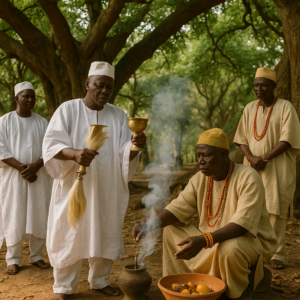
The Origin of the Orishas: Children of the Supreme Being (Olodumare)
Olodumare, the supreme creator, stands at the center of Yoruba cosmology. However, Olodumare indirectly controls the universe; he delegates his powers to the Orishas; deities that intermediate between the heavens, Orun, and Earth, Aiye.
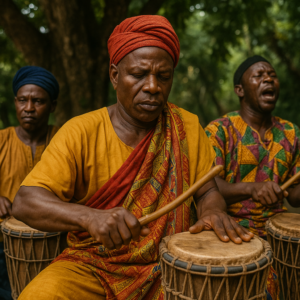
The Yoruba creation story teaches that the gods actively shape rivers, mold humanity, direct lightning, guide destinies, and heal both bodies and spirits.Their stories are told with drum rhythms, praise poetry (oríkì), masks, festivals, and other daily rituals throughout West Africa. They are not faraway gods, but family, companions on the path of life.
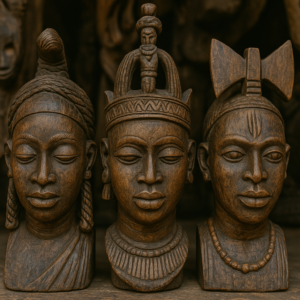
Meet the Major Orishas
Ọbatala: The Orisha of Creation, Purity, and Wisdom
Ọbatala is the elder of the Orishas: calm, venerated, patient, and wise. He shapes human form, assigned by Olodumare to mold the first humans from clay. Clad in white, Ọbatala represents:
- clarity of mind – the ability to see truth without confusion
- Justice – fairness rooted in divine order
- moral order – choosing right even when it is difficult
- peace – the quiet strength that calms storms within and without
His temples are quiet places where people go for forgiveness, counseling, and purification of thoughts. Ọbatala teaches that wisdom is not loud; it is steady.
Shango: King of Thunder, Fire, and Justice
Along with Orishas, few are as iconic as Shango, the historical king of Oyo who, after death, became divine. His presence is bold — thunder roaring, fire crackling, drums pounding.
Shango represents:
- masculine energy – the raw, pulsing energy of life
- leadership – the charisma and authority of a king born to command
- Justice – a fierce protector of truth and moral balance
- power – the unstoppable surge of thunder and flame
His holy symbol, double-headed axe (ose), represents his dual characteristics. “With one blade, he destroys liars, oppressors, and cowards. With the other, he protects the innocent, the loyal, and the truthful.”
To honor Shango is to honor courage, truth, and righteous anger.
Yemoja: Mother of Waters, Mother of All Orishas
“Yemoja is among those Orishas most dearly beloved, being no other than the eternal Mother, whose energy permeates all rivers, seas, wombs, and all other loci where new life begins.”
- She is that mother that never tires.
- The sea that never empties.
- The Healer with soft, chill, and very healing touch.
She (Yemoja) rules over fertility, motherhood, intuition, emotional harmony, and the secrets of water. She has a soft but immense energy that has the tranquility of still water and the force of a rising tide.
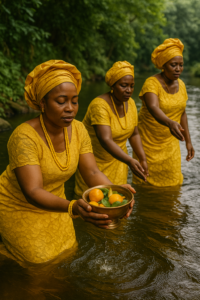
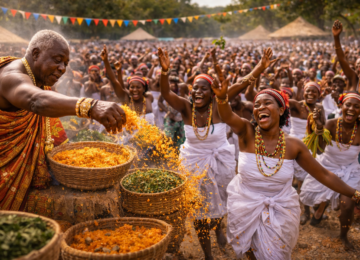
Every year, thousands of devotees assemble along rivers and shores, from the Ogun River to the shores of Bahia, to celebrate her feast. There are devotional songs, drumbeats, and waves crashing in a ritual where devotees make their offerings into the water, believing that she would bear her burdens.
Yemoja is the mother of dreams, emotion, creativity, and rebirth in addition to being the mother of children.
Oshun: Orisha of Beauty, Love, Rivers, and Sweetness
The Yoruba say: “No sweetness comes into the world without Oshun.” And in truth, her influence is seen in all those places where happiness flows. Oshun is also known as the Orisha of fertility, love, prosperity, diplomacy, and all of femininity.
“She moves like golden water; soft yet unstoppable, carrying in her the potent.”
Symbols of her are shimmering with significance: sunlit rivers, honey dripping with promise, yellow fabric that shines like mornings, and bangles that ring like laughter. Oshun has been called upon in situations where there is tender love, where finances are stuck, where a delicate touch in a relationship is needed.
“Beauty is not vanity, it is strategy, it means using your assets to advance your goals.” This sweetness can melt iron. That can undeceive where force would destroy. “Where Oshun passes, life proliferates
Ogun: The Iron Warrior and Patron of Technology
Ogun is the Orisha associated with iron, innovation, metalwork, war, hunting, and, by extension, modern technological advancements. It is he who represents irresistible energy that cuts roads, cuts down forests, produces tools, and drives machines. All things start, as a prelude, with Ogun clearing a path. Ogun represents:
- determination – will to continue on with life despite having a road full of obstructions ahead.
- craftsmanship – the art of working metal, wood, or code into tools for humanity
- resilience — capacity for resisting pressure, heat, conflict, and adversity
- transformation – from raw iron to civilization, from chaos to order, from ideas to reality
Also in ancient times, Ogun walked with people who were either hunters or blacksmiths. To honor Ogun is to honor work, innovation, creativity, and the fierce dedication that goes into making something that will outlive its creator.
Babalu-Aye: The Healer of Plagues and Protector of the Sick
Babalu-Aye is the Orisha who walks between sickness and salvation, governing healing, disease, and the mysterious borderlands of life and death. His presence commands fear, respect, and the deepest reverence because he carries both in his hands: the weight of affliction and the blessing of relief. His followers believe that he can assuage outbreaks, soothe the suffering, and place a shield of protection over entire communities.
From ancient plagues to smallpox and even modern pandemics, Babalu-Aye has stood as a test of time throughout history. He reminds the Yoruba that resilience is a God-given phenomenon, that healing may come in many forms, and that even during the bleakest seasons, recovery is possible.
Esu: The Divine Messenger and Keeper of the Crossroads
Misunderstood by outsiders, Esu is not a devil. He is the sacred keeper of choices, guardian standing at each crossroads where human destiny must choose. Esu is movement, possibility, and consequence. The divine messenger carrying prayers up and responses back to earth. He embodies the commitment of the political organization to the ideology itself.
- choice
- fate
- Communication
- crossroads
- divine justice
In Yoruba philosophy, Esu does not allow anything in this universe to stagnate. He reminds the people that every action has an equal reaction, every word carries power, and every path demands responsibility. The shrines to Esu are at crossroads, markets, and thresholds, where life makes a turn and new journeys begin. He opens some doors and closes others while teaching that the roadways we travel are determined by more than fate; courage, wisdom, and intention.
Esu teaches that every decision opens one path and closes another. It suggests that fate favors those who decide knowingly.
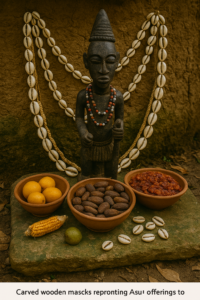
The Orishas Across the African Diaspora
When enslaved Africans were transported to the Americas, they brought with them, in their remembrance, music, and secret rituals, the Orishas. Today, Yoruba religion prospers in:
- Brazil (Candom)
- Cuba (Santer)
- Haiti (Vodou practitioners)
- Trinidad and Tobago
- United States (Ifá communities)
The continuing strength of Orisha worship is proof of the strength and powers of Africans.
Conclusion
The Yoruba tradition is not an artifact of times gone by, but a vital and living spirituality still influencing millions today. It is with the presence of the Orishas that Africans were able to integrate philosophy, psychology, ethics, medicine, ecology, and art.
There is a story for every Orisha.
Each story reveals a truth.
Every truth contains the pulse of Africa.
To seek out the Orishas is to seek out the soul of West Africa, which is colorful, insightful, and timeless.



I like this post, enjoyed this one thanks for putting up.
Pingback: African Cosmology: How Ancient Africans Understood the Universe - Real African Diary
Pingback: Cowrie Shells in African Spirituality - Real African Diary