










































































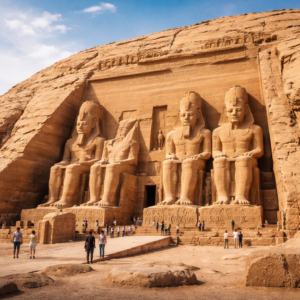
Abu Simbel Temples
Possibly the most awe-inspiring temple of all ancient Egypt with its gargantuan rock-cut façade. The great Sun Temple of King Ramses II at Abu Simbel was created in honour of the mighty King Ramses II. Guarding the entrance to the temple and hewn into the side of a mountain are four colossal statues of the pharaoh himself. In a fit of precision and architectural egotism, Ramses II had the entire temple carefully angled and oriented in order that the sun’s rays would align twice a year on his date of his ascension to the throne (21 February) and on his birthday (21 October) and illuminate the inner sanctum of the temple. This incredible natural phenomenon provides for a most spectacular sight. It has come to be referred to as the Sun Festival of King Ramses II.
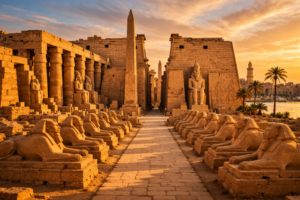
Karnak & Luxor Temples
The temples of Karnak and Luxor are some of the most striking relics of ancient history in the world. Karnak stands as one of the largest temple complexes in the world. Successive pharaohs expanded it over hundreds of years. The complex consists of four distinct sections. Four distinct sections form the Karnak complex. Only the Amun-Re precinct is open to the public. The Luxor temples, magnificent and overall form an exceptionally significant part of the rich history of Egypt as they were the site where many of the country’s kings were crowned.
It goes without saying that no trip to Egypt isn’t complete without exploring the ancient grounds on which these temples sit.
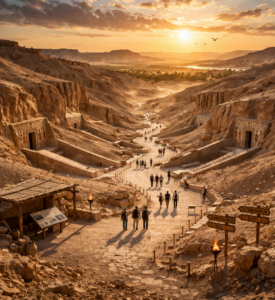
Valley of the Kings
The Valley of the Kings sits in ancient Luxor, a city over 4,000 years old. Here, ancient Egyptians carved tombs for their greatest pharaohs into the desert hills and decorated many of them with vivid colors and sacred symbols. Inside, sarcophagi once held the mummified kings, prepared for their journey to the afterlife.
Some of the best known tombs are those of Seti I, Amenhotep II and of course, the tomb of King Tutankhamun. In all, more than 60 opulent and lavish tombs have been excavated. There are at least 75 tombs in Biban al-Harim, the Valley of the Queens, around 2 of which are open. Deir al- Bahri, otherwise known as the famous Temple of Queen Hatshepsut, rises out of the desert plain in a series of terraces. Partly rock-cut, partly freestanding. It is one of Egypt’s finest and most photographed monuments.
Pyramids of Giza
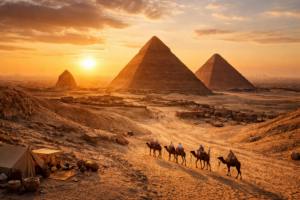
As the only survivors of the ancient Greek-listed Seven Wonders of the World, the incredible Pyramids at Giza are the world’s oldest attraction. Known as Cheops, Chephren and Mycerinus. A highly skilled corps of mathematicians, masons, surveyors and stonecutters did the job of building the Pyramids.
For centuries, people believed that 100,000 slaves built the Great Pyramid of Cheops by carrying and laying its massive stones. Recent evidence however challenges this view. Archaeologists have discovered “workers’ villages” and tombs filled with supplies for the afterlife. This shows the pyramids were built by skilled, paid workers. Once again, it proves how advanced the Ancient Egyptians were.
Aswan & Philae Temple
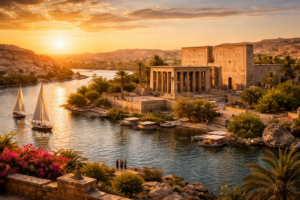
The picturesque town of Aswan is set on the River Nile and serves as the starting point for both the felucca journey downstream to Kom Ombo and optional Abu Simbel excursions. The laid-back Nubian town of Aswan is a true highlight for visitors. Colorful markets bring the town to life, while the scent of rich spices fills the air. The town features Pharaonic and Roman ruins and preserves treasures from ancient Nubia. Visitors can explore these sites and sample the restaurants along the corniche. Head out by boat to Agelika Island to explore the Temple of Philae belonging to the Ptolemaic and Roman periods. The largest monument of the island is the temple of Isis – occupying about one quarter of the island.
King Tut Exhibit, Egyptian Museum
Discovered intact in 1922 by Howard Carter, the Tomb of Tutankhamun is possibly one of the most dazzling archaeological finds ever. Tutankhamun lived over 3,300 years ago during the New Kingdom period. For two centuries, Egypt had ruled as a world superpower, while its royal family lived an opulent lifestyle. King Tutankhamun’s solid gold funerary mask and his priceless cache of treasures entombed with him for his journey to the afterlife, are now on display at the world-famous Egyptian Museum in Cairo. With the brand new Grand Egyptian Museum slated to open sometime in 2025, this famous mask alongside Egypt’s greatest ever display of artefacts is sure to be attracting visitors to Cairo for years to come.
Hurghada, Egypt
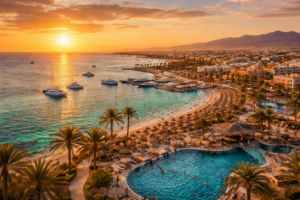
Alongside Sharm el Sheikh, Hurghada is Egypt’s premier beach resort, the perfect way to end a cultural adventure to Cairo, Aswan, Luxor and beyond. Hotels and expanded infrastructure provide holidaymakers with excellent aquatic facilities for sail boarding, yachting, deep-sea fishing, SCUBA diving and snorkeling. Hurghada’s central location provides a gateway to prime offshore reefs, which are some of the finest in the world. Hurghada draws visitors with its vibrant nightlife
For retail therapy, the town has plenty of shops selling knock-off bags and tees, snorkelling gear and suchlike. Ancient Romans established a quarry at Mons Porphyritis near Hurghada, while Port Safarga stands today as a famously windy destination and an excellent location for windsurfing.
Cairo, Egypt
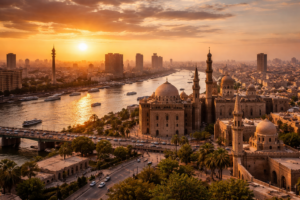
One of the most fascinating cities and the start point of all tours in Egypt. On the backstreets of Cairo tour, you’ll discover the city’s lesser-known suburbs. Make sure to also grab a bargain at the bustling Khan el Khalili bazaar and enjoy some tea at one of the nearby cafes. Another key highlight is the magnificent Islamic Citadel of Saladin and Sultan Hassan’s mosque which is beautifully illuminated at night. When the long-awaited Grand Egyptian Museum finally opens its doors later in 2025, you can add this to the long list of reasons to visit Cairo.
Peruse the site for more…




Pingback: The Forgotten Giants of Ancient African History - Real African Diary
Pingback: 10 African Destinations Every Traveler Should Experience - Real African Diary