





































Introduction
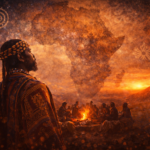
Throughout the African continent, the universe has been understood and defined by complex and sophisticated philosophical, spiritual, and environmental concepts and knowledge. Before the advent of Western science, the people of Africa created a cosmology that helped explain the origin of life, the movement of the stars, and the connection between the physical and spiritual worlds. They did not record this knowledge in books or laboratories. Instead, they preserved it through oral traditions, rituals, architecture, and sacred geography. They did not view the universe as distant or abstract; they experienced it as a connected and meaningful part of human life, ancestors, and the natural environment.
Thus, African cosmology is not only a spiritual tradition, but it is also a part of intellectual history and tradition that has defined societies in Africa.
The Universe as a Living System
In many African societies, people viewed the universe as a living system rather than a collection of physical objects in space. They understood the sky, the earth, the ancestors, and the human community as parts of a larger cosmic order, each playing a unique role within the universe.
Within this worldview, people believed that balance among these realms created harmony in society. They saw disruptions in moral order, environmental misuse, or broken rituals as forces that disturbed the cosmic balance. For example, among the Yoruba people of West Africa, communities understand the universe as a multilayered reality that includes the spiritual realm of the Orishas, the human world, and the realm of the ancestors.
Creation Narratives and the Origin of the World
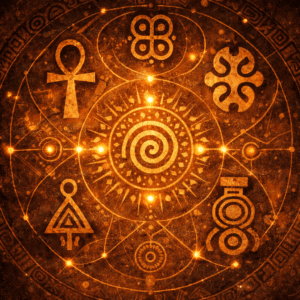
Across Africa, communities use creation myths to explain how the universe came into existence. They do not present these narratives as mere entertainment; instead, they use them as philosophical reflections on the relationship between humans, nature, and the spiritual world.
In the Dogon civilization in Mali, knowledge of the universe has traditionally been linked to the star system Sirius. The priests among the Dogon have traditionally used initiation as a way of passing on knowledge of the universe. In other instances, among the Akan people, myths of creation have been used to illustrate a supreme creator who is responsible for creating and ordering the universe.
Through creation myths, people explained how the universe came into existence. These stories connected spirituality with observations of nature.
The Sky, Stars, and Sacred Time
Ancestors and the Invisible World
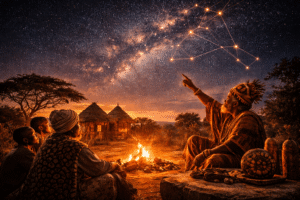
Most people in Africa believe in the idea of ancestors being active participants in the universe even after they have died. They do not believe in death as a way of being completely separated from the living world. Instead, they believe in it as a way of being in another world, which is still closely linked to the world of the living.
Most people in Africa believe in the idea of ancestors being active participants in the lives of the living. They believe in performing rituals of memory, libation, and shrine worship for the ancestors. This is a way of bridging the gap between the world of the living and the world of the dead. The idea of existence creates a universe where spiritual presence remains active in the world of the living. It does not fade away. The line between the physical and the spiritual does not separate the two. Instead, it connects them. It reminds people that there is more to life than what they can see.
Sacred Landscapes and Cosmic Geography
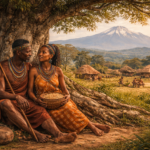
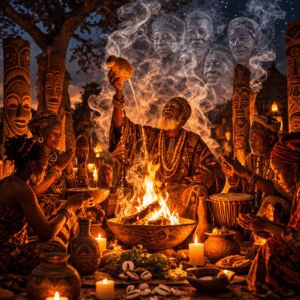
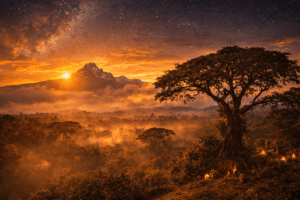
Throughout Africa, different communities believe that mountains, rivers, forests, and sacred trees are locations of spiritual power. They view these locations not as physical spaces but as living spaces in which the physical and spiritual intersect. In this way, nature becomes a metaphor for meaning, in which every hill, river, or tree has deep meaning for culture and spirituality. For example, Mount Kenya has deep spiritual meaning in the culture of the Kikuyu people. It has always been seen as the dwelling place of Ngai, the creator. As a result, it has guided the prayers and rituals of different communities. In this way, geography becomes sacred direction, which guides both spirituality and identity.
Communities also believe in different spiritual locations like the sacred grove, river shrines, and ancestral burial grounds. They perform rituals in these locations in order to maintain harmony in the cosmos, honor their ancestors, and seek guidance from the unseen world. In this way, these locations are not separate from human existence but influence it in different ways.
African Cosmology in the Modern World
The African cosmologies have a lasting influence on the philosophy, art, and identity of Africa today. Despite the emergence of modern science and its fresh perspectives on the universe, the traditional worldviews of Africa are still highly relevant today as a form of culture and philosophy. Contrary to the popular perception of the African cosmologies, they have not died out. Instead, they have evolved with the changing times. They are evident in the modern art, literature, music, and even in the environmental movement that seeks harmony with nature. They have lasting implications for the way in which people view themselves in relation to nature and in relation to each other.
The African cosmologies have started to gain traction among scholars, artists, and culture leaders today. They are seeking to reconnect with indigenous knowledge systems that were in existence before the colonial era. In doing so, they are not only preserving culture but also contributing to a global dialogue on alternative ways of looking at the universe and man’s place in it.
Conclusion
African cosmology is a profound understanding of the universe in relation to community, spirituality, and environmentalism. It is a cosmology that situates humans in the universe as a web of life that includes the ancestors, the environment, and the cosmos. These ideas have endured centuries of social change through oral traditions and rituals. They remind the world that the African intellectual tradition is a rich one with profound philosophical reflections on the meaning of existence, balance, and the structure of the universe.




Pingback: The Sacred Beliefs of the Igbo: Nigeria’s Ancient Spiritual Heritage - Real African Diary
This content is very easy to follow.
Pingback: The Kikuyu Creation Story: How Gĩkũyũ and Mũmbi Founded a Nation - Real African Diary
Pingback: How African Traditional Healers Bridge the Physical and Spiritual Worlds - Real African Diary
Pingback: Zulu Reed Dance: Purity, Unity, and the Celebration of Womanhood - Real African Diary
Pingback: Explore the Rich Cultural Tapestry of the Nyamwezi People - Real African Diary
Pingback: Exploring the Culture and Traditions of the Khoisan People - Real African Diary
Pingback: Sacred Animals in African Mythology - Real African Diary
hahahaha…