










































































Introduction
Few African authors have employed their talents in the world of literature in such an audacious manner like Wole Soyinka. Born in Abeokuta, Nigeria, in 1934, Soyinka matured into a playwright, poet, novelist, and essayist who transcended the bounds of pen and theatre in his literary works. The issues addressed in his literary works ranged from issues of power, injustices, tradition, violence, and the complicated interaction between man and society. Literature as a means of questioning the powers that be and challenging the established norm is at the core of many of his literary works. The Yoruba culture, mythologies and performance traditions formed the basis of his literary world, while his educational and professional experiences in Britain informed him on the larger European literary traditions. He incorporated both worlds without letting one define his entire literary persona.
Soyinka paid for his success through personal sacrifice, as he spent twenty-two months in prison during the Nigerian civil war due to his advocacy for peace. He won the Nobel Prize for Literature in 1986, becoming the first African to win the prize.
Early Life and Education: The Making of a Literary Rebel
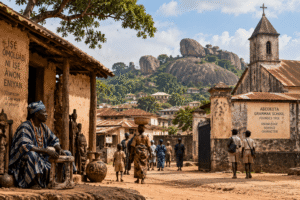
Wole Soyinka was born on July 13, 1934, as Akinwande Oluwole Soyinka in the city of Abeokuta, which is located in southwestern Nigeria. He spent his childhood in a family of Yoruba people in the times when Nigeria was still a country under the British colonial rule. Samuel Ayodele Soyinka, Wole’s father, was an Anglican priest and a school principal; his mother, Grace Eniola Soyinka, was a shop owner and a devoted community member.
Soyinka’s childhood provided him with a mix of Christian religion, Yoruba culture, colonial education and the accompanying social conflicts. These diverse factors would serve as essential components in the future works of the writer. Instead of seeing African cultural heritage and Western literature as two absolutely different spheres of life, Soyinka often merged them together. Yoruba mythology proved especially valuable for the writer; in particular, the character of Ogun, who is a god of iron, wars and creativity, appears in the works of Soyinka over and over again.
From Nigeria to Britain and Back
Soyinka attended Government College, Ibadan, and subsequently furthered his education at the University College, Ibadan, and then University of Leeds in England. Soyinka studied English Literature at Leeds where he was introduced to the dramatic traditions of Europe. He was later employed at the Royal Court Theatre in London where he received practical training in the art of play production and performance. However, Soyinka’s association with Britain went beyond his literary training.
In 1960, he returned to Nigeria which was a significant year for Nigeria as the country achieved its independence from Britain. He became more interested in African theatre and started writing plays with issues of modern day life and Yoruba performance, myths and storytelling incorporated in them. This time frame marked a defining moment for Soyinka in terms of the characteristics of his writings; intellectually challenging and at times satirical.
Major Works and Literary Themes
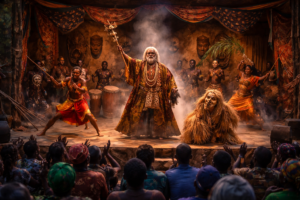
Soyinka’s world of literature is immense and multidimensional. All his plays, such as The Lion and the Jewel, Kongi’s Harvest, and Death and the King’s Horseman have humour, satire, myth, and tragedy intertwined to criticize the paradoxes of African modernism. In Death and the King’s Horseman (1975), his most popular play, Soyinka takes a second look at a traditional Yoruba ritual disrupted by the British colonizers. This is not only a collision of cultures but an examination of duty, sacrifice, honor, and the price of being unable to fulfill your holy obligation. His plays often cross boundaries between spiritual and political spheres through the use of traditional beliefs and reality of the present day.
As a poet, Soyinka’s language is militant but reflective at the same time and often addresses the issues of exile, justice, memory, and identity. His collections such as Idanre and Other Poems, A Shuttle in the Crypt, and Mandela’s Earth gave his voice as an artist and activist.
Imprisonment and Exile: The Cost of Speaking Truth
Literary development of Soyinka took place against the backdrop of his readiness to stand up to political authorities and denounce injustice. Indeed, literature for Soyinka was directly linked with the duties of citizen in the face of political power violating basic human rights. During the Nigerian civil war, Soyinka sought to promote negotiations between the warring parties and advocate an end to hostilities. He was arrested in 1967, charged with conspiracy with Biafran rebels, and spent 22 months under house arrest, including almost a year of solitary confinement, until his release in 1969. This experience had a deep effect on his literary creation. Imprisonment formed the background for The Man Died: Prison Notes; poems written by Soyinka during this period were published in Poems from Prison (A Shuttle in the Crypt).
Thus, Soyinka perceived literature not only as art form but as means to document oppression and preserve experiences that might be preferred to be forgotten by the ruling authorities. Literature was a tool to confront the oppressors and challenge the authorities.

Nobel Prize and Global Recognition
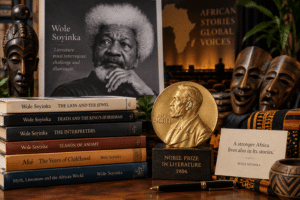
Wole Soyinka was conferred the Nobel Prize for Literature in 1986, making him the first African novelist to be bestowed with the distinguished honor. The feat not only proved to be a milestone in his career, but also in the increasing international recognition of the importance of African literature within the global framework. Soyinka won the prestigious award for his creation of a drama of wide cultural significance and poetic overtones. It proved that literature that is based upon the culture and society of Africa could gain global attention without losing touch with its culture.
Even before he won the Nobel Prize, Soyinka had become the author of many literary works of drama, poetry, fiction, autobiography and literary criticism. The themes included in his writings ranged from colonialism and political power to the mythology and history of Yoruba, personal reminiscence and social conscience. Some of his most notable works include The Interpreters, Season of Anomy, Aké: The Years of Childhood, Myth, Literature and the African World, Idanre and Other Poems and Death and the King’s Horseman.
Legacy in African Literature and Cultural Identity
Soyinka’s influence goes far beyond academia. He has inspired a generation of writers. From Chimamanda Ngozi Adichie to Ngũgĩ wa Thiong’o , who continue to struggle with the same questions of identity, justice, and memory. In universities and cultural circles throughout Africa, Soyinka’s works continue to be set texts, not simply because of their craftsmanship but because of their bravery. His vitriolic defense of Yoruba cosmology and African tradition contributed towards the recovery of indigenous knowledge systems previously disparaged by colonial education.
Even at his advanced age, Soyinka remains a public moralist; voicing outrage at religious intolerance, political accountability, and the erosion of civic virtues. His distinguished white hair has become emblematic of wisdom and defiance. The sage who will not retire from truth.
Conclusion
To say Wole Soyinka is to say Africa’s conscience. A man who turned resistance into art and liberation into word. His is the same path as that of the continent; painful, rugged, and boundlessly creative. In an era where comfort is usually more than enough to mute truth, Soyinka remembers that the role of the writer is not to placate power but challenge it. His drum-beat-counselled voice sharpened by the wrongs of the world still echoes in classrooms, theatres, and parliaments around the globe.
So long as there will be tales being told on the continent of Africa, Wole Soyinka’s name will be written in ink that will never dry.



Pingback: Pan-African Writers Who Fought with Words: From Senghor to Ngũgĩ wa Thiong’o - Real African Diary