



















































Introduction
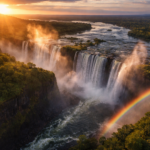
As you approach Victoria Falls, you hear it before you see it. There is a deep, unrelenting thunder that echoes through the earth. The earth shudders. The air thickens with mist. Before you see it, the Falls announce their presence. The Africans called this place Mosi-oa-Tunya, The Smoke That Thunders. The name does not embellish. The name explains. Here, the Zambezi River falls into a chasm of basalt rock with a fury that demands silence and awe. Walking alongside Victoria Falls is not like walking alongside any other falls. It is like walking alongside a force of nature.
Where Water Becomes Power
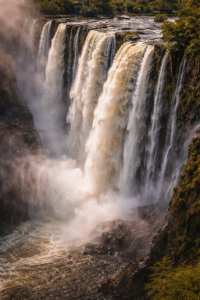
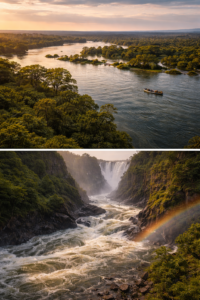
The falls span 1.7 kilometers where the Zambezi River drops dramatically into a chasm with incredible power. While most waterfalls have water cascading from an open face, the Victoria Falls funnels the elements of water, noise, and gravity into a powerful plunge. This causes a column of mist to rise hundreds of meters up into the atmosphere, visible from miles around. The locals refer to it as “Mosi-oa-Tunya,” meaning “The Smoke That Thunders.” Both aspects of this name are accurate representations of the site’s characteristics. Not only does the waterfall create a tremendous amount of noise, but it is also incredibly visual. On bright sunny days, rays of light break through the mist and create beautiful rainbows stretching on forever.
The waterfall is vibrant. It pulsates with life, absorbing the sun’s rays and reflecting them back out with its mist. The waterfall is not just a place; it moves, breathes, and commands attention.
A Sacred Landscape Before a Tourist Landmark
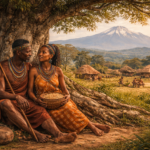
Long before Europeans came along to explore Victoria Falls, local tribes believed that the Falls were sacred. They did not see it as a tourist destination, but rather as an interface between man and the mysterious. They would talk about river spirits and forces moving amidst the spray, ancestral voices. Victoria Falls was full of memories, power, and presence. David Livingstone called it the “Victoria Falls” upon naming it back in 1855. But he did not strip it of its essence and soul name. In Africa, Mosi-oa-Tunya, “the smoke that thunders”, has been recognized as the Falls’ name long before any outsider came. And it remains relevant to this day.
Sacred geography teaches one to be aware of the fact that some locations may have more significance than mere physical presence. Sacred spaces represent a whole range of stories and legends, beliefs, and associations that reach far into past generations and bind people to this land with invisible strings.
Walking the Edge of Thunder
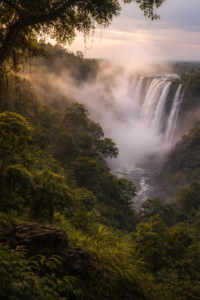
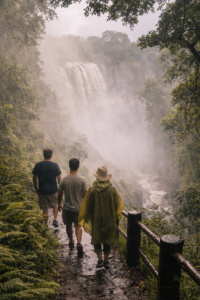
As one walks along the rainforest trail alongside Victoria Falls, water sprays all over the body like falling raindrops. There is no respite from the roar of the falls; it follows one everywhere, filling one’s ear drums and resonating in the soil beneath the feet. The rainforest depends wholly on the spray of water from the falls to survive. Plants such as ferns, vines, and trees thrive on the water mist, creating a vibrant green ecosystem that relies solely on the waterfalls for survival. In this area, water rules over all aspects of life. One does not just watch the waterfalls but becomes an integral part of the scene. Shoes get drenched with water, and the camera lens gets fogged up by the mist. Every breath feels heavy with the misty air surrounding the visitor.
There is no room for escape from the force of the falls. Instead, visitors are enveloped in its power, which demands complete attention.
The Zambezi: Calm Before Fury
Above the falls of Victoria, the Zambezi River flows with serene assurance. Wide and strong, it mirrors the clouds in tranquil waves that give no indication of the violence that awaits downstream. The fishermen steer their boats across it with ease. The birds soar, dive, and ascend, all unhindered. The river seems to flow with patience, as if it has all the time in the world. And then it is not so anymore. The calm gives way to turbulence as the river nears the edge. It speeds up, twists in on itself, and rushes headlong into the abyss with an overwhelming force. What was once so tranquil takes on new life, a wild current rushing through rapids and cutting through rock.
There is a larger lesson here as well. The river proves that serenity and ferocity can coexist. Gentleness does not negate strength; quite the opposite, gentleness sometimes masks it. This principle echoes in the hearts of Africans and their history throughout the continent.
Why Victoria Falls Still Matters
Victoria Falls is important for many reasons. First and foremost, this magnificent sight brings back the sense of perspective. The world we live in is based on the ideas of control and precision. In such a world, it is hard to remember that there are things and processes that exceed our authority. Victoria Falls is here as a reminder that despite what people say, not everything can be controlled or mastered. Secondly, the falls remind people that we share the planet. Victoria Falls is located on the border between two countries; Zambia and Zimbabwe. While the Falls belong neither to one country nor to the other, they belong to both at once. They transcend borders by being a part of the shared heritage.
Last but not least, the falls remind people that they do not have to create their identity in Africa. Africa is not something that needs to be beautified. Africa is amazing on its own.
Walking Away Changed
You walk away from Victoria Falls wetter, quieter, and more cognizant. There is still moisture in your skin, as well as memories of the noise long after it faded. There is something different inside of you. It is not an experience confined by the edge of the Falls alone; instead, it is an experience which follows you even after the fact. You do not “conquer” Mosi-oa-Tunya, which means “The Smoke That Thunders.” You neither dominate nor contain such a place in photos or other representations. Rather, you pass through it humbly, in awe and fear at what you see before you. The Falls are never yours; rather, you are theirs, if only temporarily.
The reverberations of the Falls follow you. They are not limited by the ear but instead live on in your mind, reminding you of their sheer scale and power, their naturalness. Even more than that, though, the echoes remind you that certain places are too sacred to own and possess, no matter how grand they may seem.