


















































Introduction
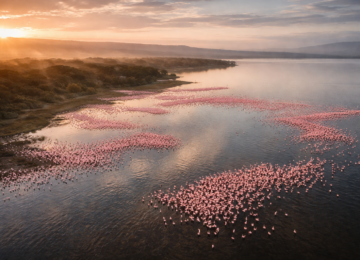
When the dawn breaks at the Lake Nakuru National Park, the waters of the lake do not sleep just yet. Feathers flap the waters, voices flutter through the air, silhouettes of of pink, white, black, and silver hues rise, settle, and disturb the waters. The birds have defined the landscape here; the birds have composed the landscape.
Lake Nakuru rests in the Rift Valley of Kenya as though it were a shallow mirror that reflects not just the sky above it, but also spirit and soul. For as long as any know, it has attracted birds of every sort from all corners of Africa and beyond. What arises is not disorder or chaos; rather, it is an orchestrated movement, symphony and motion danced out as though guided by wind and waters.
Flamingos
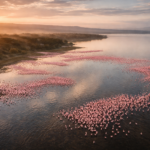
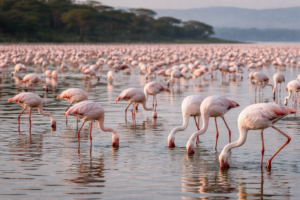
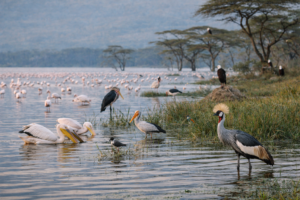
No other species embodies the identity of Lake Nakuru more than the flamingo. During specific seasons of the year, massive crowds gather on the shores of the lake to create a breathtaking display of wildlife in the country. The birds have their source of food from the micro-algae and other organisms thriving in the shallow waters. The lesser flamingos are numerous, covering the shores with their bright pink feathers, while the greater flamingos stand out with their light-colored feathers and long legs.
They spend their days feeding, grooming, and relaxing together in perfect synchronicity. This makes watching them almost spellbinding, as they perform their daily routine in perfect harmony with the other members of the flock. On seeing a danger nearby, the birds take off into the air in unison, making the sky full of clouds made up of wings beating furiously. However, within a short while, silence is restored, and the flock resumes its gentle murmuring and activities.
Pelicans, Storks, and the Weight of Wings
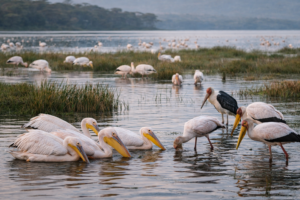
Whereas flamingos might have all the glory, it is the pelicans who set the pace in the lake. White pelicans fly over the lake in elegant formations, leaving shadows in the air which appear to be gliding living clouds. They are very social animals and tend to fish in groups by forcing the fishes into the shallower water and then capturing them with their big bills. Such cooperative hunting tactics create an amazing display of their power and beauty.
In the marshes around the lake, one comes across the presence of various storks. Big and graceful, storks tend to dominate the scene due to their majesty and wisdom. Yellow-billed storks fish carefully in the lake for food, using their long bills. Meanwhile, marabou storks stand guard on the edge of the water. They look serious and majestic, as if playing the roles of the wise elder members of this great community.
Each bird seems to play its part in creating the perfect ecology of Lake Nakuru.
Migrants, Residents, and the Gift of Passage
Over 400 different types of birds call Lake Nakuru home, making the location one of the best places for bird watching in all of Africa. These birds include migratory species that fly in from other continents and parts of Africa. Others make their nests in the grasslands surrounding the lake and never leave. Each of these species creates an ever-changing tapestry of bird-life.
The grebes seem to effortlessly glide across the water, leaving minimal disturbances to the reflective surfaces below. The herons stay perfectly still until they suddenly strike at their prey with deadly accuracy. The kingfishers dazzle onlookers with their bright turquoise feathers, which flash brilliantly whenever they fly from branch to branch above the water. Every season, new species visit the area to provide variety.
The birdlife at Lake Nakuru shows an important principle about continuity and change in nature. While the seasons change, different generations come into being, and various species migrate to and from the area, there is always new bird-life. It is this ability to thrive through change that creates continuity.
Water, Balance, and a Fragile Harmony
The birds of Lake Nakuru survive due to a very delicate ecological balance that has been created over thousands of years of existence. Several species of birds, such as the flamingos, survive through dependence on the alkaline nature of the lake, and the presence of microorganisms, including algae. The slightest shift in factors, like levels and quality of the water in the lake or availability of food sources, results in migration. When pollutants enter the lake through upstream sources or due to climate change resulting from shifts in rainfall and evaporation levels, the entire ecology will be affected, resulting in birds seeking alternative habitats. With recovery of the ecology, the birds will eventually migrate back to the lake.
In light of this realization, it has become important for conservationists to take action to preserve the habitat of the birds and their catchment areas. The survival of Lake Nakuru is dependent on the maintenance of its surrounding ecosystem just as much as it is dependent on maintaining the health of the lake. It is important to conserve these birds by conserving their entire system of existence.
Conclusion
The endurance of Lake Nakuru relies on its reliance on interconnectedness and balance. Birds rely on water. Water relies on the earth. The earth, on the other hand, relies on the nurturing and neglect it receives. Every flamingo, pelican, stork, and kingfisher are elements that work together, along with their environment in which they live. Together, climate, vegetation, wetland, and the people surrounding the place form one large narrative. When all these elements work in perfect harmony, the lake survives, along with all the birds inhabiting it.
To walk along the shores of Lake Nakuru and see thousands of birds fly above your head is to hear Africa speak without using any words. Every wing movement, every season, and every migrating bird tell a story of how the birds fight in order to survive and adapt to the environment around them. This is not just an entertaining sight to see; it is a constant rhythm of survival and continuity.