Introduction
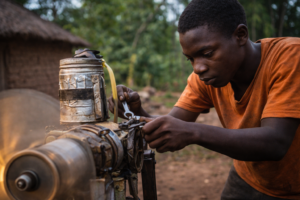
Ernest Andrew grew up in a small African village in Malawi where, as he remembers, “darkness falls without mercy by four every evening”. But this young man did not accept the fact that the ability to use electricity is the right that only other people have. Without waiting for help from the government or any outside assistance and advanced equipment, he used his own curiosity, persistence, and inventiveness. By using the scrap material, learning about the laws of air flows, and using his hands, Ernest built his own generator.
Thanks to this invention, today nine families of Ernest’s village can use electricity absolutely free of charge, without consuming fuel, oil, or any batteries. The case of Ernest Andrew shows how even the most primitive methods can become revolutionary under certain circumstances and due to inventiveness and persistence of a person. Ernest’s story teaches people who have accepted their circumstances to recognize opportunities for innovation and persevere in improving their lives.
A Dropout Who Refused to Drop His Dreams
Ernest did not attend school for long since poverty deprived him of many opportunities, rather than lack of ambition. This case can be likened to many other African talents who had their education cut short by poverty long before they could make full use of their potential. However, though he left the classroom, he left no room for thirsting to gain knowledge through informal means. His constant observation about the interaction of wind, pressure, rotation and balance gave him an insatiable appetite to know more about the machines.
Instead of waiting to be given a chance, Ernest took matters into his own hands. With pieces of metals, electric fans and bicycle parts, he made a machine which would generate energy from wind. Rather than just a theoretical approach to the issue, he used what he got in order to make a generator that could actually convert the energy of moving air into energy.

Power Without Fuel, Oil, or Batteries
Rural electrification initiatives largely rely on diesel engines, solar panels, and expensive technologies that most of the rural poor cannot afford. Ernest, on the other hand, took a different approach. He built a generator that uses the wind to spin turbines and produce electricity. This process does not require any fuel, oil, or batteries, therefore, it is clean and cheap to operate. It proves that there is always a solution to every problem.
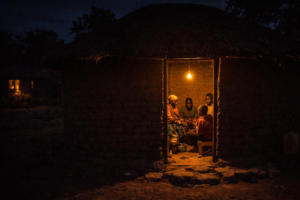
The innovation of Ernest provides electricity to nine houses in his village for free, thus, changing people’s lives in ways unimaginable before. Children can study after sunset, families can cook without racing against daylight, and neighbors can gather under electric lights. Moreover, local small businesses can work more, which will help to make more money. For those villagers, who have never had access to electricity, it means a lot. They finally get the chance to have something that was considered a luxury before.
Lighting More Than Homes
Ernest’s success cannot be gauged by the number of houses he has electrified. What makes his discovery even more significant is the potential he opens up for the future. The flicker of each light bulb after dusk symbolizes extra hours spent in learning, working, and imagining. After changing the homes of his neighbors, Ernest’s vision of change now extends to the village school from where he was compelled to withdraw due to lack of money. His dream is for the coming generation to have better chances than he ever had.
Ernest sees bright classrooms long after the sun sets at night. His desire is to see young children reading by the bright electric bulbs and not by candles or even the kerosene lamps. He does not want education to stop just because the day is gone. Through his innovation, Ernest seeks to create a classroom where young children can pursue their studies without any break. Through his invention, he seeks to make it possible for the youth of tomorrow to dream big.
In this regard, Ernest rewrites the African dropout story. He proves that education is important but self-education is transformative.

African Innovation at Its Purest
Innovation in Africa has not ceased in any way; Africa’s most outstanding innovations have not been limited to institutions of higher learning, research labs, but also in village open spaces, farm fields, backyards, as well as workshops made of iron sheets, wood, and determination. Ernest Andrew is an example of the great African innovators whose inventions come from experiencing problems first-hand rather than seeking help from anywhere else. He and many others do not look up to anyone else since they know that they can use their creativity and local ingenuity to better their communities.
There is nothing extraordinary about the manufacturer of Ernest’s generator, but there is much about its purpose. Ernest designed this generator not to attract investors or make headlines, but to solve a problem that many African families face every day. It does not need fame as much as it needs to have an impact. Ernest’s generator shows how important it is to understand the needs of people in order to innovate. It is the product of technology which is born out of the soil of its community.
When Youth Become Infrastructure
Governments develop power lines. Firms develop power stations. Ernest Andrew developed possibilities. Despite being only 18 years old, he managed to accomplish something that some major projects fail to do; to provide power supply to those families living in darkness for years. With nothing but scrap materials, passion, and ingenuity, he managed to show that young people are not just the recipients of development but its makers. The story of Ernest proves that by developing the ingenuity of its young members, any community opens the way for development.
Ernest’s success does not lie in the engineering. Instead, it lies in the fact that he changes the perception of how the world looks at African villages. His invention becomes proof of the fact that the African villages have more than just needs; they have ingenuity and talent too. He shows that the future of Africa does not lie in its infrastructure but in its young minds.
Conclusion
The scope of Ernest’s vision is far greater than his current capacity to power nine houses from his generator. In fact, he hopes to further develop his invention to make it more efficient and then help other rural communities construct similar generators using inexpensive and locally available materials. The vision of this man is not about keeping this wonderful technology to himself, but rather about spreading it so that all of Africa would benefit from easy-to-use clean energy.
Ernest’s story demonstrates that Africa does not lack any inventions; it lacks an opportunity to see them. Ernest believed in his ability to do everything even when nobody believed him and, therefore, showed more than just a generator but a possibility for other young Africans. Maybe Ernest’s main invention is not the generator but the belief that everything is possible.