Introduction
In Africa, some of the most innovative technologies have been discovered not in complex laboratories or expensive research facilities, but rather in makeshift classrooms, overcrowded townships and villages, where ingenuity surpasses the lack of materials. Countless young African inventors have proven through their work that imagination is not stifled by scarcity, and one of the most impressive cases was that of Simon Petrus, a Namibian high school pupil who supposedly invented a mobile phone that could make calls without a SIM card and airtime.
The story of Simon Petrus was known to everyone in 2016, after spreading across the African continent and captivating many youths. He did not come from a well-to-do background, but from a place common to many Africans who knew very little about technology. Regardless of how one sees it, whether as a groundbreaking technological innovation or just a young boy’s ambitions, the story of Simon Petrus shows that the greatest innovations come out of curiosity and boldness.
Who Is Simon Petrus?
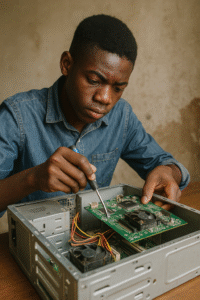
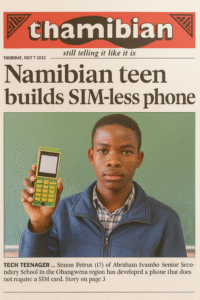
Simon Petrus was a Grade 12 learner from Abraham Iyambo Senior Secondary School in Ohangwena Region, Namibia, which is mainly a rural place and far away from any major technological or industrial hubs in Namibia. Similar to many other young African learners, he grew up in a society where the access to advanced technology was scarce and innovative activities were hard to pursue. Instead of viewing technology as something which one must have from the outside world, Simon decided to turn into its creator rather than its user.
Through the support of several encouraging teachers and using N$150 (which is equal to US$10-$15) which his parents gave him, Simon started accumulating different pieces of electronic junk such as wires, chargers and old parts of devices. By dismantling them, learning from them and assembling again, he educated himself about electronics in an experiment-oriented way. Using the limited amount of material but unlimited creativity and imagination, he managed to turn useless junk into a base for his revolutionary creation.
The SIM-less Phone: How It Worked
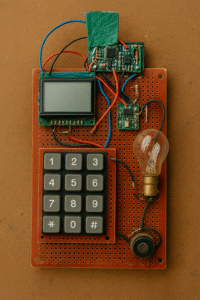
Unlike typical mobile phones, which use SIM cards, cell towers, and other network-related services to function, it is reported that Simon Petrus designed his phone in such a way that it can communicate via radio frequency (RF). The region’s media reports suggested that the phone has an ability to transmit sound signals by means of radio waves without needing any SIM card and airtime to make a call. During the demonstration process, the gadget managed to connect with telephone lines as well as certain mobile phone numbers gaining lots of popularity due to its unconventional manner of communicating.
However, Simon was not satisfied with just the voice call feature of his invention. He added several additional features into it such as television, radio, fan, and even light bulb, indicating his desire to make the device multifunctional and useful despite the lack of resources. Although the phone had nothing to do with commercial smartphones and was not produced on a large scale, it impressed school officials as well as journalists present during the demonstration of the invention. Constructed from the junk parts of electronic devices, scrap copper, motherboards, and other recycled materials, Simon’s invention became a bright example of African inventiveness.
Why This Invention Matters — Beyond the Device
Despite Simon’s phone not having hit the market yet, its importance cannot be reduced to just engineering. The invention started off a debate on how Africa can generate innovative ideas. Not only did Simon create something new and exciting but he demonstrated how people in areas which lack resources can produce ideas which are innovative. This invention has shown that great ideas do not come from sophisticated equipment but from people’s desire to learn.
Most importantly, Simon’s success brought the focus not on the invention itself but on the young inventor who made it possible. It became an illustration of the fact that in the minds of African people there could exist a great number of talents and inventions that need to be discovered.
It Proved African Talent Exists Everywhere
Through his invention, Simon Petrus proved that genius is not only reserved for Silicon Valley, renowned universities, and globally acclaimed research facilities. In Africa, innovative young people have continued to solve challenges through their ability to apply creativity and determination despite the scarcity of resources that they face. Innovation starts in classrooms filled with dust, workshops located in remote places, and even in humble homes. This can start with nothing but curiosity and determination.
Without having access to any laboratory, state-of-the-art tools or sponsorship from any company from a school in northern Namibia, Simon invented something that got recognition all over the world. The invention defied the notion that any innovation would be possible only when there were adequate resources. The reality is that the genius lies in all corners of Africa. What is lacking is not intelligence and ambition but avenues for its growth.
It Challenged the Idea That Africa Only Consumes Technology
Africa has for a long time been viewed as a recipient of technological innovations and not an innovator. This is because most gadgets in use in the continent are made, designed, and patented somewhere else. The innovation that Simon made proved that even young people in Africa are capable of coming up with their own technological innovations to suit the environment around them.
Irrespective of whether the prototype was ready for commercialization or not, it certainly sent a clear message about Africans being able to design, experiment and build innovations of their own. It is not all about perfect products, well-known brands or giant companies when talking about innovation. Innovation can also come from experimentation, perseverance and solving day-to-day challenges using what one has at hand. The phone that Simon developed was more than just a school project. It brought about a change in thinking that Africans do not always have to rely on other countries for solutions but can design and develop innovations to solve their own challenges.
It Inspired a New Wave of Youth Innovators
The success of Simon inspired numerous youngsters to view science and technology from a different perspective. With increased media reports about his invention, there were indications that science clubs, electronics, and engineering projects received more attention from Namibian schools. Youngsters, who did not dream about becoming inventors before, have started fixing radios, disassembling old computers, and working with used electronics.
His example showed the world that innovation did not have to come from professional engineers or from rich entrepreneurs alone. Innovation could start from an ordinary school class with the right mindset and motivation. Schools started motivating their learners to apply creative thinking to solve practical challenges, while communities found value in technical curiosity as a virtue. Simon was an idol to many youths in Africa who saw that age, origins, and monetary constraints were no hindrance to innovating.
It Highlighted Education Inequality
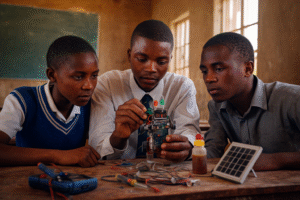
Possibly Simon’s greatest accomplishment was in posing an uncomfortable dilemma: If one student with practically nothing could invent something like that, what kind of inventions would hundreds of millions of African students be able to create if given the right support? On one hand, his invention is a story of incredible potential of young Africans; on the other hand, this invention is also a story of the inequalities that prevent this potential from being realized.
In most parts of the continent, children continue learning without laboratories, power supply, up-to-date books, Internet connection, or competent guidance. Talented students do not get a chance to realize their ideas, since the necessary infrastructure simply is not there. Simon’s invention shows that the problem of Africa is not lack of intellect or inventiveness. The problem of Africa is the lack of investment into education, science, and technology. Today, somewhere in a remote classroom, there is potentially the next great inventor of Africa. But the realization of this potential requires not the discovery of talents, but their adequate development.

Conclusion
Petrus Simon’s invention is not just the tale of a brilliant teenager, but an inspiration of the endless potential of the entire continent of Africa. Regardless of whether or not the prototype becomes a commercial success, the story tells us that innovation can be born out of curiosity rather than wealth, determination rather than privilege. In every classroom, laboratory, or village across Africa, there are children thinking up solutions for problems that have yet to be identified elsewhere.
The lesson of Simon’s story is that Africa cannot depend on foreign inventions alone for its future. The continent’s future will belong to its innovators — children courageous enough to think and create and push forward. With the right combination of talent and opportunity, the next revolutionary invention need not come from the world’s greatest laboratories, but from an ordinary African classroom.